
Tiny image sparks big backlash in Nikon photo contest
To play this video you need to enable JavaScript in your browser.
This video can not be played
-
Published
The winning entry of a prestigious scientific photography competition is being re-evaluated following criticism from other scientists that it was made with AI.
Nikon’s annual Small World In Motion contest accepts photos and video taken using powerful microscopes, and has run annually for the last 15 years.
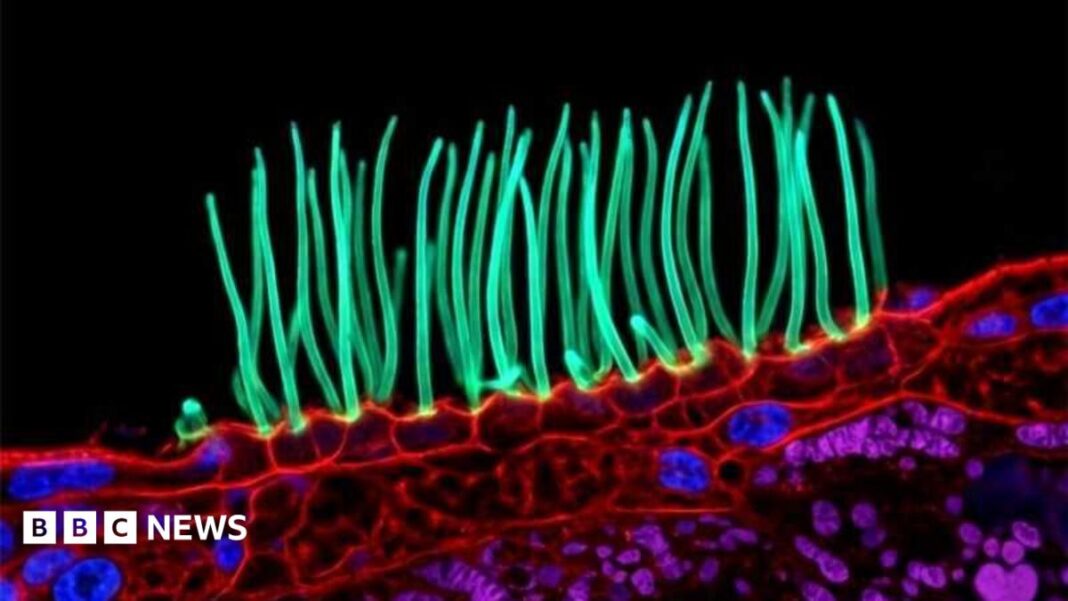
The winner was a short video submitted by Dr Ning Xu, a researcher at Tsinghua University in China, which claims to be footage of tiny, hair-like structures called cilia moving inside the airways of a child with a rare disease.
Xu did not respond to the BBC’s request for comment, but has posted online denying he broke the competition rules.
In a response to a post by Nikon on LinkedIn, external, he did not dispute using AI within the image processing but said he remained within the rules of the contest.
“AI was not used to generate the experimental movie, the cilia, or their motion,” he said.
Xu’s video is artificially brightly coloured – common in microscopy and permitted in the contest – which is usually done manually using stains and dyes on the sample itself.
He accepted AI was used “to distinguish and visualize features in the reconstructed grayscale images”.
But the challenges made by other scientists include claims that the video contains shapes and movements which did not fit with normal cell structures or behaviours, and that the cilia seemed to be too big.
Commenting on Nikon’s social media post, Edward Phelps, associate professor at Florida University, observed some of the structures “pop in and out of existence” and the cilia “appear from nowhere”.
Meanwhile PhD student Ian Donovan from UT Southwestern Medical Centre said the source image appeared to contain a distinctive watermark indicating it had been AI generated.
Additionally, two former competition judges said they also had concerns about whether the image was real.
‘Respectfully complying’
Nikon said Xu was “respectfully complying” with its investigation and had provided it with additional technical documents.
Dr Patrick Hickey, who came fifth in the 2026 Small World contest, said the recognition the award represents means more than the $3,000 (£2,250) prize itself.
“If you spend a lot of your time in a dark room looking down a microscope, it’s really nice to be able to show people and to show the public,” he said.
“There’s an interesting fusion between science and art, and a lot of the images that scientists are making have some very abstract and artistic qualities to them.”
Hickey said it would be unfair on other entrants if it turned out the winning video was unfairly altered by AI.
“There’s a specific set of rules in the contest, and one of them was quite clearly that you couldn’t use generative AI to produce things, and the other was obviously that it has to be taken under a microscope,” he said.
So far, Nikon is standing by its procedures but it said there would be an update soon.
“At this time, we don’t see that any rules were violated,” it said in a statement.
-
OpenAI unveils AI assistant ‘dots’ while safety worries delay new model
-
Published20 hours ago
-
-
Chinese AI tool told researchers how to make bioweapons
-
Published1 day ago
-

Sign up for our Tech Decoded newsletter to follow the world’s top tech stories and trends. Outside the UK? Sign up here.