
This post was originally published on this site.
Ask most people what a sleep problem looks like and they will describe lying awake. It is the image the entire category is built on: the dark ceiling, the clock, the slow accumulation of hours you are not going to get back. And for a great many people it is exactly right.
But it is only half the picture, and the half that gets missed is the reason a lot of sleep products end up in the bin.
What Normal Actually Looks Like
Sleep researchers use the term sleep onset latency for the gap between lights out and being asleep. In a healthy adult it usually sits somewhere between ten and twenty minutes. Under five minutes consistently tends to indicate significant sleep deprivation rather than an enviable talent.
Consistently over half an hour, night after night, is where people start describing themselves as bad sleepers.
What that number does not capture is what happens after you have fallen asleep. A person who takes forty minutes to drop off and then sleeps solidly has one problem. A person who is asleep within five minutes and then fully awake at ten past three has an entirely different one. Both will type the same thing into a search bar, and both will be offered the same products.
The British Complication
The UK sits in an unusual position here. Melatonin, sold over the counter across most of Europe and the United States, is a prescription-only medicine in Britain. The most commonly prescribed sleep medications (z-drugs and older benzodiazepines) come with NHS guidance that explicitly limits long-term use, for good reason.
That leaves a considerable middle ground occupied by botanical supplements, and it is a crowded, uneven middle ground. Some products in it are well built. A great many are underdosed, padded out, or combine ingredients in ratios that bear no relationship to how those ingredients are actually used.
What Actually Acts On Falling Asleep
The plants with the longest history in this specific job are consistent across European herbal tradition: valerian root, hops and lemon balm, usually in combination rather than alone. They are the traditional answer to the problem of a nervous system that is still running at the point the body wants to shut down, and they are taken shortly before bed because that is when the job needs doing.
Valerian root is traditionally used to help maintain natural sleep. The health claim for this botanical
is awaiting authorisation and is used under transitional provisions.
The important and rarely stated point is that these are evening ingredients. They work on the evening you take them in. They are not doing anything about the reason you were wound up in the first place, and they are not doing much about waking at three.
Why The Second Problem Needs Something Else
Waking in the small hours is generally discussed in terms of the overnight cortisol curve. In a well-regulated night, cortisol stays low through the early hours and climbs towards morning. When that curve runs early or steep, people surface before they have finished sleeping, and they surface alert rather than drowsy, which is why getting back down is so difficult.
Nothing about that pattern shifts in a single night. It is a system that moves over weeks. Magnesium, along with vitamins B6 and B12, sits on this side of the problem: these nutrients contribute to the normal functioning of the nervous system, to normal psychological function, and to the reduction of tiredness and fatigue. Body stores of magnesium also fill gradually, which is why anything on this side is a fortnight-scale question rather than a first-night one.
The Two-Speed Approach
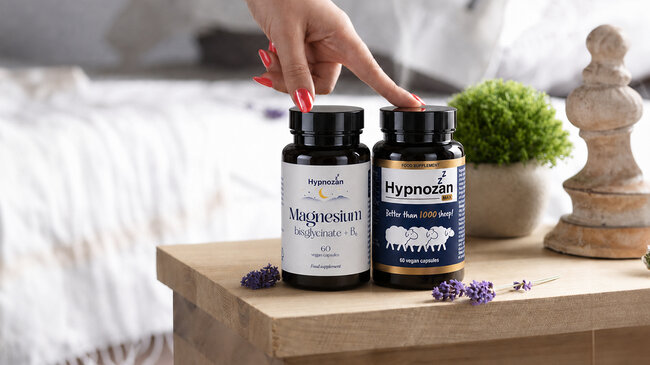
One UK product has built its whole structure around this split. The Hypnozan 8H Program is sold as two bottles taken across the same evening: a botanical capsule built around valerian root with lemon balm, motherwort and hops, taken half an hour before bed, and a separate magnesium bisglycinate with vitamin B6 taken earlier with food.
The logic is that these are two different jobs running on two different clocks. The botanical side works from the first night. The magnesium side is the slow, quiet one, and it is the part that determines whether the good nights become the default rather than something achieved individually each evening. Which is also why it is presented as a programme to be taken continuously, rather than as a capsule to reach for on the bad nights.
The Unglamorous Part
None of this replaces the basics, and the basics are genuinely more powerful than any supplement: a consistent wake time, daylight early in the day, caffeine cut off well before evening, and honesty about alcohol, which reliably shortens the time it takes to fall asleep and reliably wrecks the second half of the night. Persistent sleep problems, particularly with daytime symptoms, are worth a GP appointment rather than a shopping decision.
But for people who have the basics roughly in order and still cannot get the transition to work, knowing which of the two problems you actually have is the single most useful thing you can establish. It is the difference between buying something that addresses your night and buying something that addresses somebody else’s.