
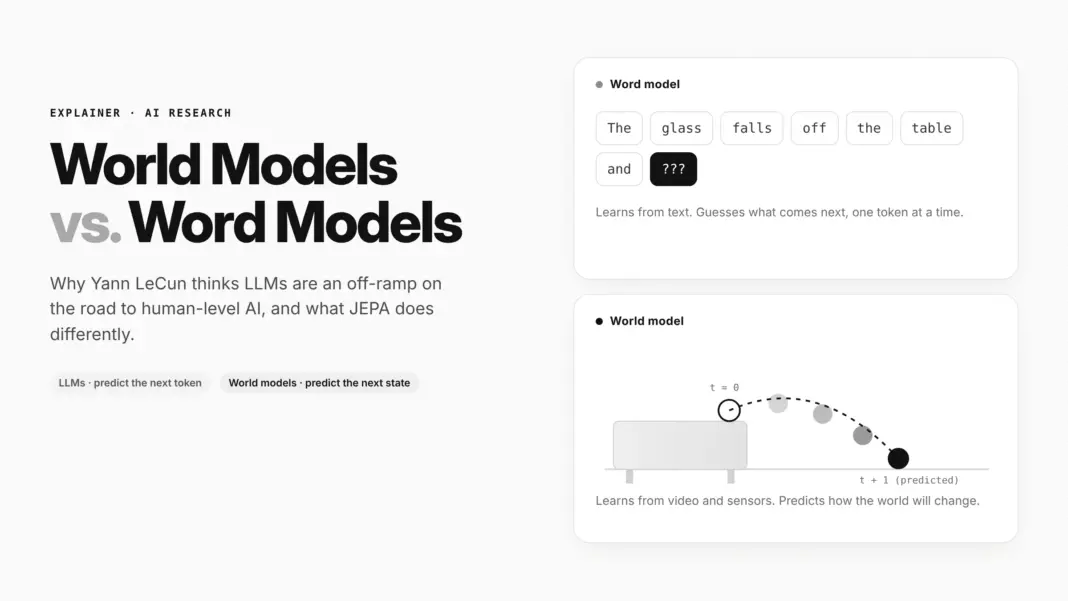

Ask a chatbot what happens when a glass falls off a table, and it will describe the outcome perfectly. Ask a robot to handle that same glass, and things become considerably more complicated. This gap between describing the world and understanding it lies at the heart of world models.
Yann LeCun, former Meta’s AI chief, believes LLMs cannot bridge this gap through scaling alone. In this article, we explore his reasoning, the alternative he proposes, and its limitations.
Table of contents
What is a World Model in AI?
A world model lays out how an AI perceives the world. The crux of a world model is the question: “If this happens, what follow?”
You use this throughout the day when you are playing catch. You do not think about applying physics to perceive the path of a ball. You have simply trained yourself to estimate where the ball will land. You know that a closed door will swing open when pushed. You know that a cup will fall from the shelf when partially kicked out. There was no school to teach you this doctrine.
The argument is a straightforward one. True intelligence needs this type of model to predict outcomes and develop a future plan. This demonstrates how two different methodology’s function:
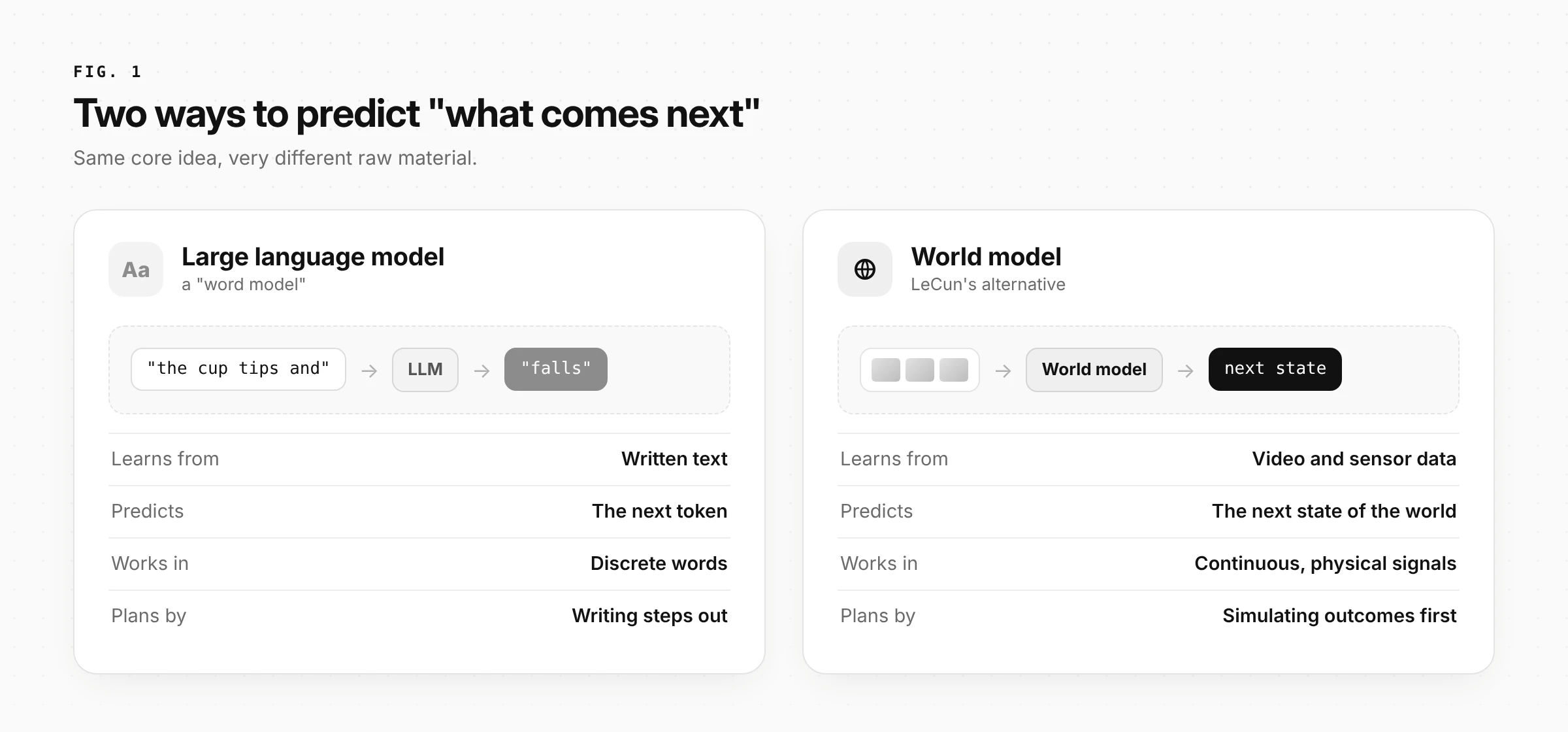
- LLMs learn through text, predicting each token
- World models learn using sensory modalities like video, predicting future events
- LLMs produce outputs one word at a time without mental rehearsal
- World models simulate many possible scenarios and choose the best
Why Does Yann LeCun Think LLMs Are a Dead End?
LeCun isn’t saying ChatGPT is useless. He’s saying scaling it up won’t get us to human-level intelligence. His argument rests on four missing pieces.
1. Text is a thin slice of reality
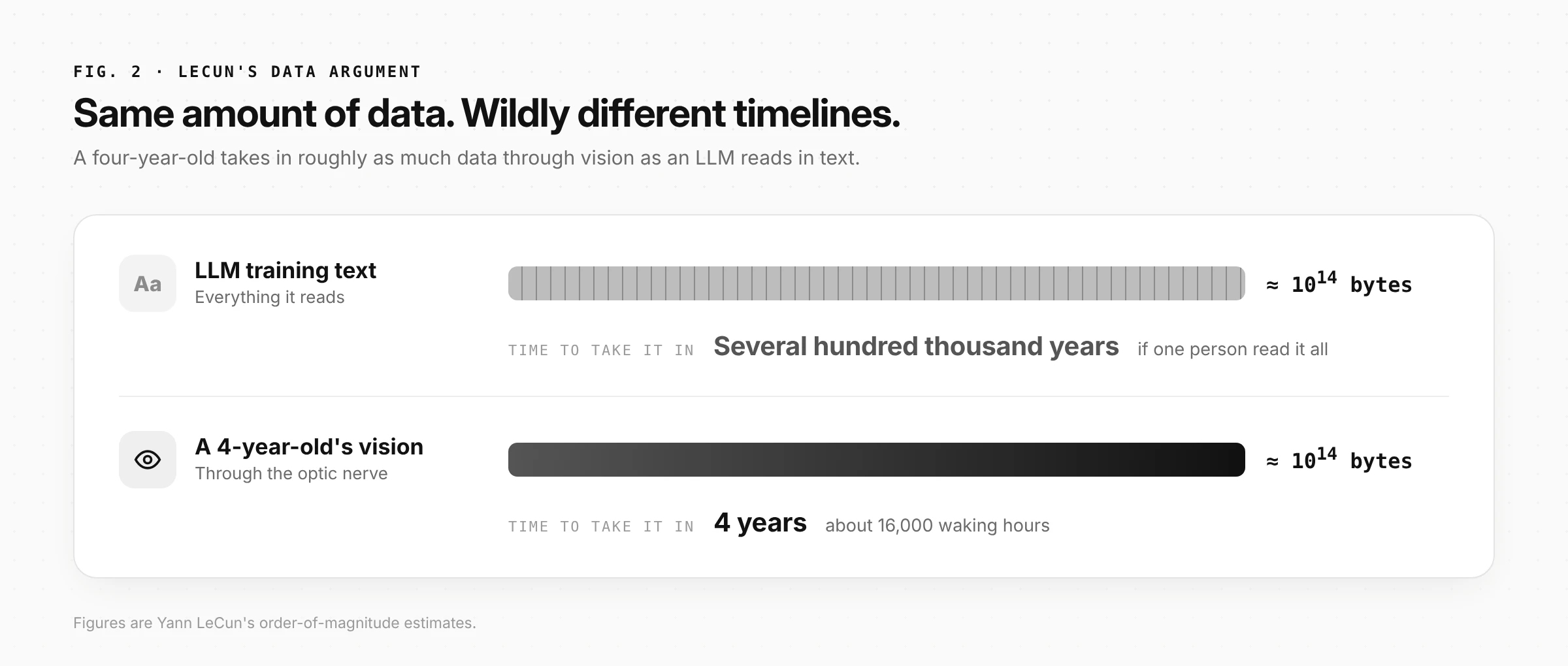
Here’s his favorite comparison. A big LLM trains on roughly 10¹⁴ bytes of text. A person would need several hundred thousand years to read all of that.
Now think about a four-year-old. They’ve been awake for about 16,000 hours. Their eyes have pushed a similar amount of data into their brain. That’s the same volume, in four years.
So, the child isn’t short on data. They’re just getting a different kind. It’s continuous, messy, and physical. Text only captures what humans are bothered to write down.
2. Generating one token at a time isn’t reasoning
In this case, LeCun draws information from Daniel Kahneman. The LLM generates one token, and then subsequently the next token, and then it generates another token thereafter, in a very speedy and reactive method, similar to the concept of “System 1”. There is no phase where it stops to think about its strategy.
However, reasoning models with long sequences of thoughts make this distinction a little less clear. They’re still searching through text, not through a model of the world.
3. No persistent memory
An LLM operates based on context windows. Once the chat is over, there’s nothing left of its learning experience, unlike a child’s painful experience, which becomes forever engraved in their memory.
4. No concrete planning capability
An abstract task, like “prepare breakfast,” would generate an ideal list of actions from an LLM, but it won’t even make a guess on whether this would work in the kitchen.
LeCun ends with a point he likes to make. We do have AI that can pass the bar exam, yet where is the robot as smart as a cat?
That’s an example of Moravec’s paradox. Things that we find difficult, such as writing essays or playing chess, can be done easily by machines, while things that are easy for toddlers, such as stacking blocks, are very complicated for robots.
The “Blurry Future” Problem: Understanding via Code
HHere’s a question that confuses many. Why not simply train a model to anticipate the next frame of a video? Isn’t that a world model?
LeCun asserts that this is not the case, however, and gives a surprisingly simple explanation.
Imagine a ball at the center of a small screen. In the next frame, it either moves to the left or right. It’s a coin flip. Let’s train a simple predictor on this and see what it outputs.
import numpy as np

rng = np.random.default_rng(0)
SIZE = 7 # a tiny 1D "screen" with 7 pixels

def frame(pos):
    f = np.zeros(SIZE)
    f[pos] = 1.0
    return f

# Ball starts in the middle. Next frame: it jumps left OR right, 50/50.
X = np.array([frame(3) for _ in range(1000)])
Y = np.array([frame(rng.choice([1, 5])) for _ in range(1000)])

# Train a pixel predictor with plain least squares (MSE loss)
W, *_ = np.linalg.lstsq(X, Y, rcond=None)
print(np.round(frame(3) @ W, 2))
Output:
[0. 0.46 0. 0. 0. 0.54 0. ]
Look at that. The model predicts half a ball on the left and half on the right. That ball never exists in reality. It’s the average of every possible future.
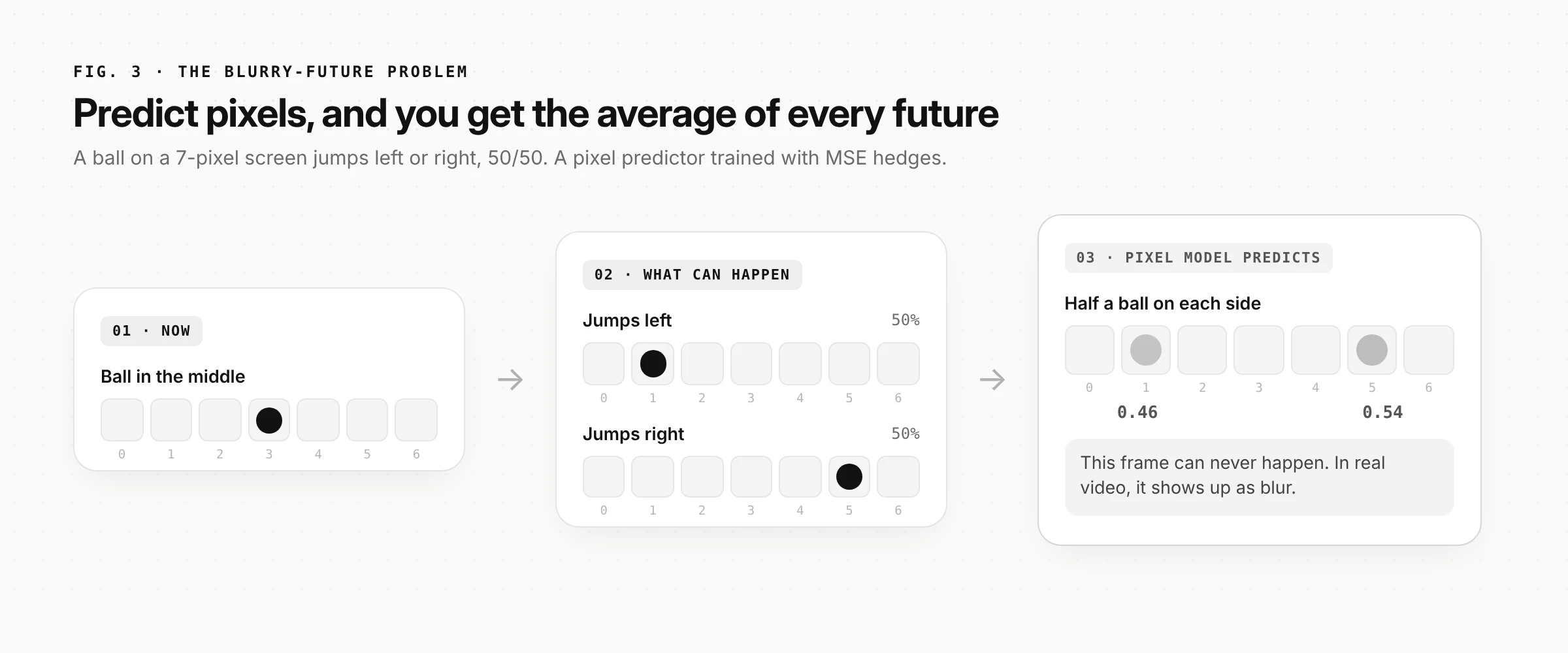
This is exactly why early video prediction models produced blurry frames. Drop a pen and it can fall in any direction. A pixel predictor hedges and smears it everywhere. Real videos have thousands of unpredictable details like leaves, shadows and ripples. The model wastes its effort guessing all of them.
How Does JEPA Fix This?
LeCun has offered the solution in the form of JEPA, which stands for Joint Embedding Predictive Architecture. The details about this architecture were shared in his 2022 paper titled, “A Path Towards Autonomous Machine Intelligence”.
The new approach was to abandon the idea of predicting pixels, and instead, predicting in the space known as abstract representation space or latent space. It is done in three steps:
- An encoder converts what is seen by the model to the compact form.
- The next encoder makes a summary of the part that is hidden or is forthcoming.
- And finally, a predictor attempts to calculate the second summary from the first.
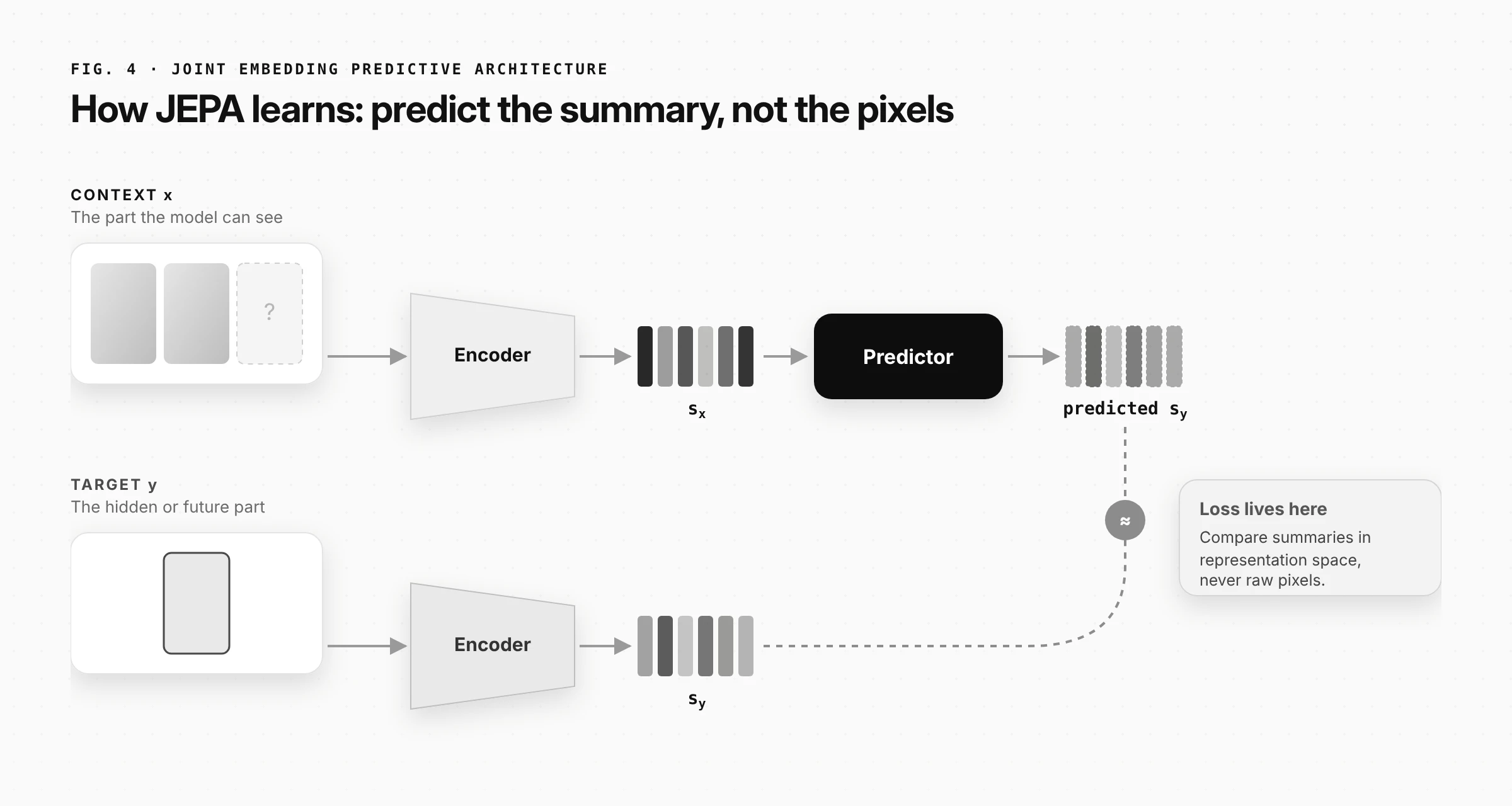
Thus, the model doesn’t need to require drawing every particular leaf, but rather needs to predict what is important. The encoder is trained to discard details that cannot be predicted anyway.
Let us take our example using the ball again, but this time we encoded the ball differently: we kept how much distance it traveled, but instead of which direction it went.
import numpy as np

rng = np.random.default_rng(0)

def encode(pos):
    # Keep what's predictable: how far the ball is from the centre.
    # Drop what isn't: which side it went.
    return abs(pos - 3)

nexts = rng.choice([1, 5], size=1000)
z_next = np.array([encode(p) for p in nexts])

print("unique targets in latent space:", set(z_next.tolist()))
print("predicted next latent:", z_next.mean())
Output:
unique targets in latent space: {2}
predicted next latent: 2.0
The target is now singular. The forecast is clear, not vague. The system has correctly identified “the ball has gone forward two movements”. The flip of the coin has been disregarded.
A little honest note, I created that encoder by hand for demonstration purposes. In actuality, the JEPA will work by learning how to make the encoder autonomously. This is challenging and where the majority of the research work lies.
From I-JEPA to V-JEPA 2: Does It Actually Work?
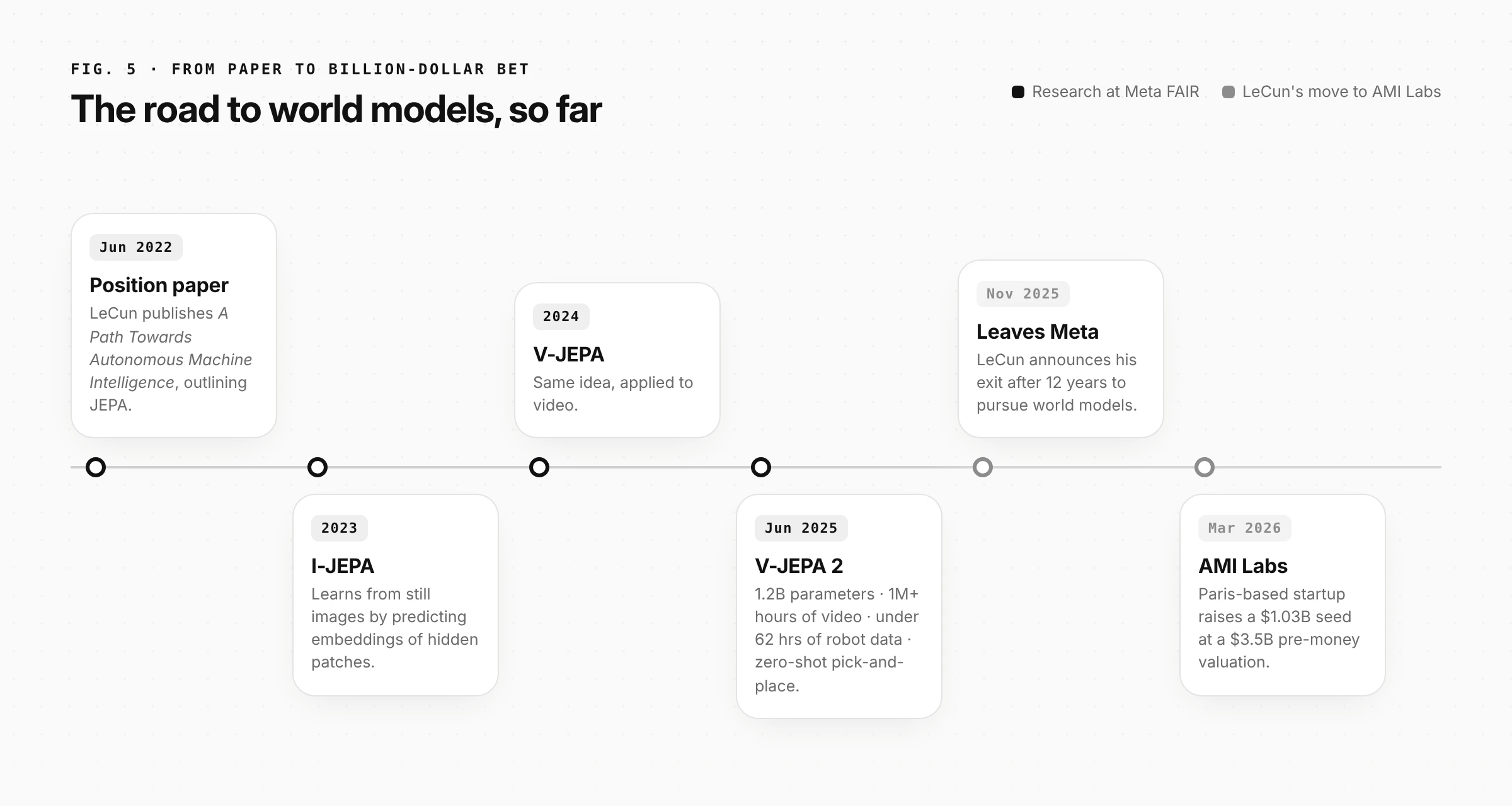
JEPA is not just a slide diagram but a starting point from which Meta’s FAIRE team created a series of models:
- I-JEPA (2023): trained on still images to predict missing parts of images and represent them as embeddings.
- V-JEPA (2024): performed the same prediction, but for videos.
- V-JEPA 2 (June 2025): a 1.2 billion parameter model trained on more than a million hours of video footage.
V-JEPA 2 is the one that attracted people’s attention because upon completion of internet video pre-training, Meta introduced a small action-aware layer. The system was trained on less than 62 hours of video footage featuring robots, which came from the open access DROID dataset.
Then they dropped it onto Franka robot arms in two different labs. The arms handled reaching, grasping and pick-and-place in rooms they’d never seen. Nobody collected data from those labs first. Tasks were given as a simple goal image: “make the scene look like this.”
That’s a big deal. Most robot learning needs piles of task-specific demos.
How Planning with a World Model Works?
So, how exactly does a robot use a world model while taking an action? A robot visualizes beforehand and then moves. It tries out a number of ways to perform the task in its mind. Then it chooses the method that will bring the predicted launch to its desired destination.
Here is a small example of this process. The world we are living in consists of positions represented as a line and one obstacle at position 4.
import itertools

ACTIONS = [-1, 0, 1] # move left, stay, move right

def world_model(state, action):
    # Learned in real systems. Hand-written here.
    # A wall sits at position 4, so you can't pass it.
    nxt = state + action
    return state if nxt == 4 else nxt

def plan(start, goal, horizon=4):
    best, best_cost = None, float("inf")
    for seq in itertools.product(ACTIONS, repeat=horizon):
        s = start
        for a in seq:
            s = world_model(s, a) # imagine, don't act
        cost = abs(goal - s)
        if cost < best_cost:
            best, best_cost = seq, cost
    return best, best_cost

print(plan(start=0, goal=3)) # ((0, 1, 1, 1), 0)
print(plan(start=0, goal=6)) # ((0, 1, 1, 1), 3)
Plan number one works the way it was intended. Plan number two fails because the wall obstructs its progress. It still goes as far as possible and stops, not needing to crash into something to get there. It knows thanks to the model.
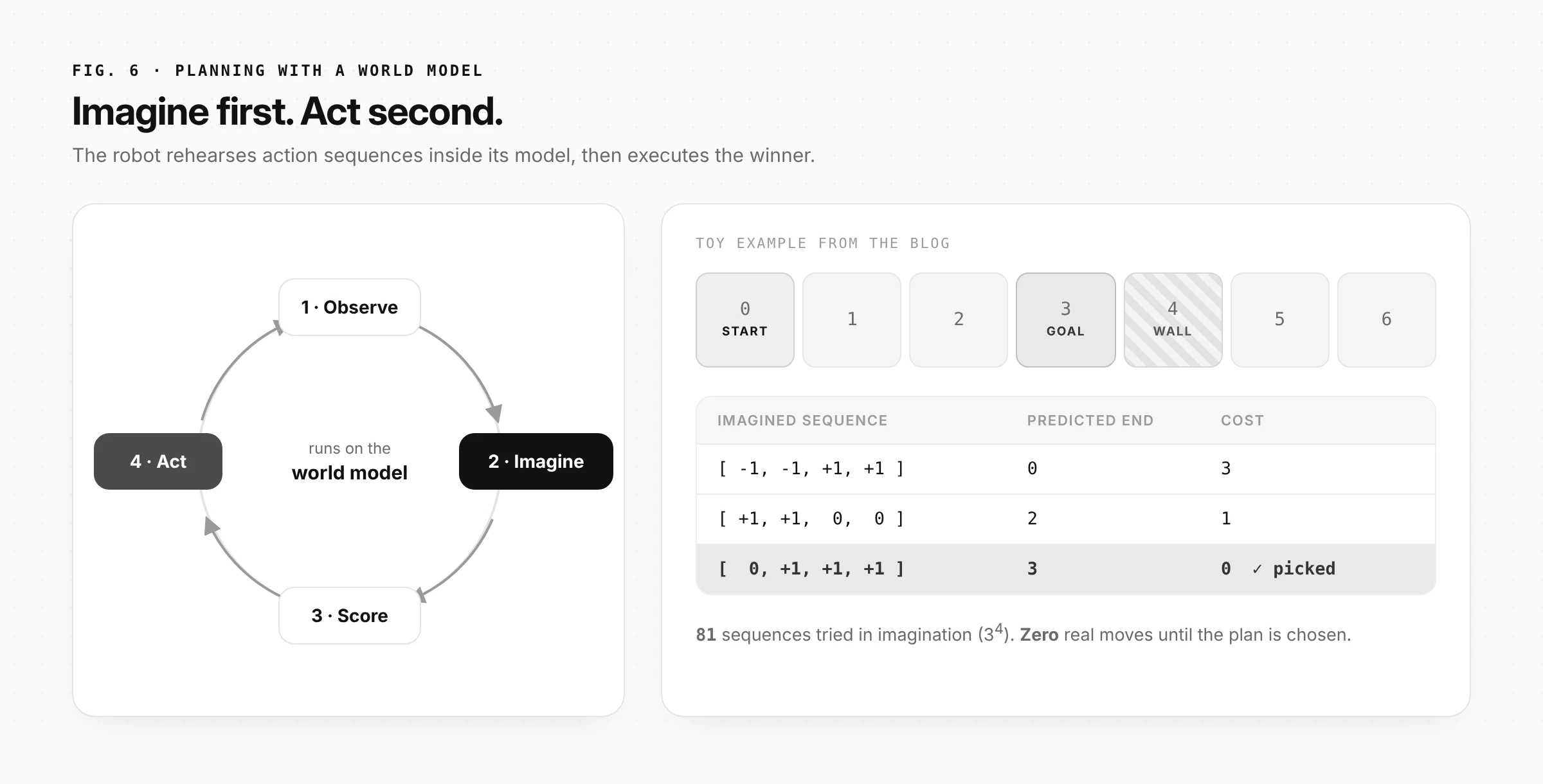
V-JEPA 2 does exactly the same, just in a much bigger dimension. It matches its predicted embeddings with those of the goal image. It also uses its intelligence to do more than simple brute force methods.
Gotchas: Where World Models Still Struggle
It’d be lazy to pretend this is solved. It isn’t. Here’s what still trips things up:
- The possibility of collapse, a lazy algorithm can behave the same way every time, making predictive approaches an exercise in futility. Much research has been done in the area of JEPA concerned with preventing such occurrences.
- The planner is only as good as the model. If you get rid of our wall and see how it works, it will invariably lead you back to the wall.
- Limited time horizon, V-JEPA 2 demonstrates the ability to plan for several seconds in advance, but it does not yet excel in performing long-term tasks.
- Outcomes do not warrant optimism. Moving a cup, the things demonstrated today, is something a toddler does instinctively.
What Do LeCun’s Critics Say?
Plenty of smart people think he’s wrong. Their arguments are worth hearing:
- Firstly, text conveys a significant quantity of physics. People regularly talk about falling, pushing, and destroying objects. As a result, LLMs learn a lot of physical principles by hearing the speech of other humans. For instance, LeCun pointed out an example: when you push the table, the book on it shifts. He said text-only models would never learn that. Today’s models handle that example easily.
- Secondly, the finance and the products contradict him. Every significant lab continues to progress in language models and improve their efficiency in programming, mathematics, and operating with tools.
- Finally, the solution might be not binary. There are already humanoid robot developers who share functions between language and motor control networks. A combined future with LLMs performing language functions and specific networks dealing with physical tasks seems to be realistic.
In my opinion, LeCun is correct that only text creates a gap in understanding. Whether LLMs are a dead end depends on the goal pursued. When it comes to coding, the answer is no. When a robot performs laundry folding, I agree with him.
AMI Labs: The Billion-Dollar Bet
LeCun announced his Meta exit in November 2025. In March 2026, his new startup went public with its plans. It’s called AMI Labs (Advanced Machine Intelligence). It’s headquartered in Paris, with teams in New York, Montreal and Singapore.
The numbers are wild for a company with no product. AMI raised $1.03 billion in seed funding at a $3.5 billion pre-money valuation. It’s widely reported as Europe’s largest seed round ever. Alexandre LeBrun is CEO. LeCun is executive chairman and still teaches at NYU.
LeBrun put the thesis neatly: “reality is not tokenised.” It’s continuous, noisy and high-dimensional. Their first targets include robotics, healthcare, industrial control and wearables. They’ve also promised to keep publishing papers and open-sourcing code.
Conclusion
World models reverse the traditional approach adopted in AI. LLMs put their prediction emphasis on the next word, while world models predict the next world’s state. JEPA follows that principle but processes it in a more abstract way, effectively avoiding blurry future problems. V-JEPA 2 demonstrated that it could easily operate a real robot despite minimal training.
Is Yann LeCun right when he claims that LLMs are dead ends? If we speak about chatbots, then the answer is probably negative. For machines acting in the real world, the case for world models is strong.
Read more: Positional Embeddings Explained: How LLMs Understand Word Order
Frequently Asked Questions
A. LeCun believes text is a thin slice of reality that lacks the continuous, physical, and sensory data required for machines to develop true human-level intelligence.
A. Predicting pixels leads to blurry outcomes because the model tries to average all possible future scenarios instead of focusing on the most likely, abstract representation.
A. JEPA predicts in latent space rather than pixel space, allowing the model to ignore unpredictable details and focus only on essential, high-level information.

Data Science Trainee at Analytics Vidhya
I am currently working as a Data Science Trainee at Analytics Vidhya, where I focus on building data-driven solutions and applying AI/ML techniques to solve real-world business problems. My work allows me to explore advanced analytics, machine learning, and AI applications that empower organizations to make smarter, evidence-based decisions.
With a strong foundation in computer science, software development, and data analytics, I am passionate about leveraging AI to create impactful, scalable solutions that bridge the gap between technology and business.
📩 You can also reach out to me at [email protected]
Login to continue reading and enjoy expert-curated content.