
When Clearscope first came out, I became a power user almost immediately.
I was writing and optimizing dozens of SEO articles, and it saved me masses of time: type in a keyword, and it pulled the top-ranking pages, worked out the topics they had in common, and showed me how well my draft lined up against them. No more reading ten articles and keeping a mental tally of every subtopic.
We used it heavily at my content marketing agency for years. But times have changed a lot since then.
And today, a lot of content work no longer happens in a content editor at all. More and more people write, research, and edit inside Claude Code, ChatGPT, and other AI tools, so they want an API or MCP server their AI can call, not another interface to log into. They also want keyword data that goes deeper than search volume, without paying for a second tool.
So I wanted an up-to-date look at the best Clearscope alternatives, and how they fit a modern AI content workflow. I compared ten of them on price, cost per article, API and MCP access, and how well they plug into the rest of your SEO process.
What Clearscope (and every content optimization tool) does
- Topic overlap: They analyze the top-ranking pages for your keyword and find the topics, terms, and questions those pages have in common.
- Topic recommendations: They turn that analysis into a list of things your article should cover, so you can spot gaps before you publish—or when you want to update it.
- A content score: They grade your draft (usually 0–100, or A to F in Clearscope’s case) against the competition, so writers, editors, and clients all have a simple number to aim for.
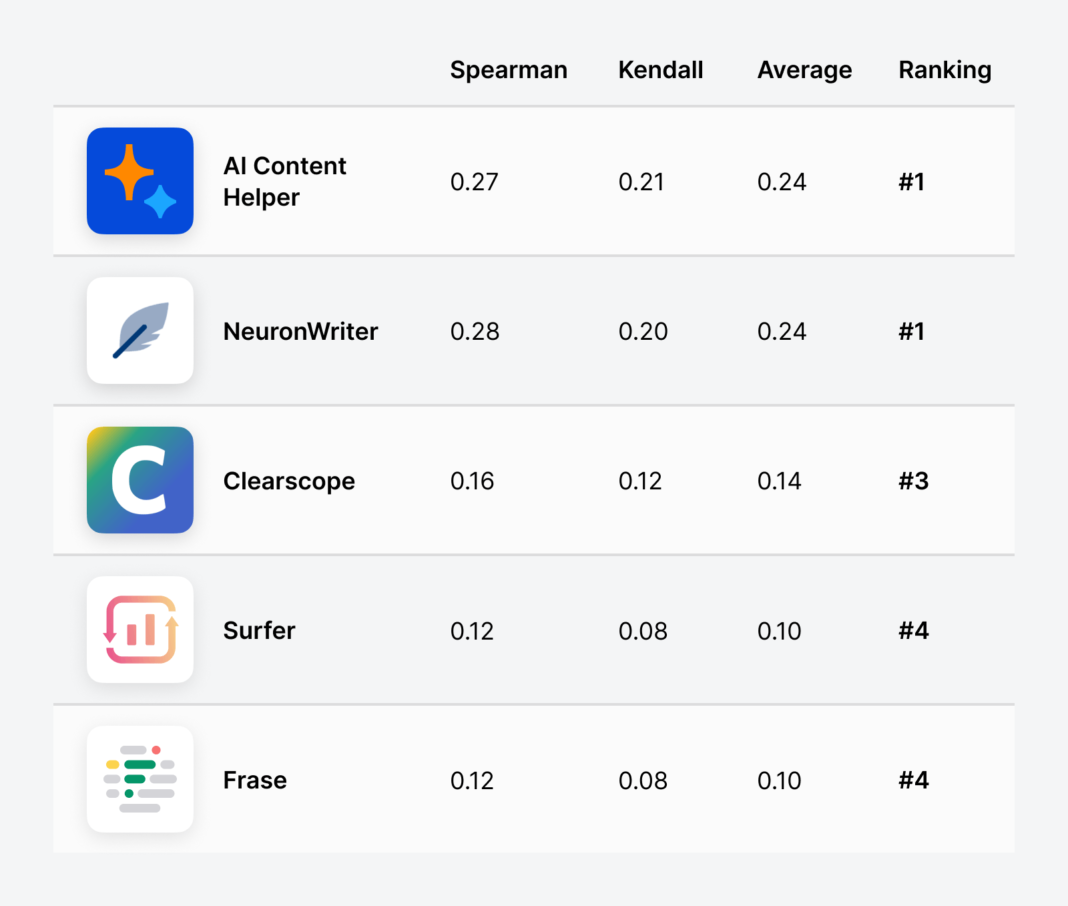
That’s a big deal. Most ranking factors (backlinks, brand, site history) are hard and slow to change. Topic coverage is one of the few you control completely. Louise on our team used AI Content Helper for quick article updates and saw traffic to those articles grow by around 72% on average.
Clearscope alternatives compared
|
Starting price |
Optimized docs on entry plan |
Cost per doc |
Keyword data built in |
|||
|---|---|---|---|---|---|---|
|
NeuronWriter |
Gold ($69) and up |
Gold and up |
No: SERP analysis only; GSC shows your own queries |
|||
|
Ahrefs AI Content Helper |
Free, then $99/mo |
1 (free), 50 (paid) |
Yes: Ahrefs keyword database |
|||
|
30 reports |
Every plan |
Every plan |
No: SERP analysis only |
|||
|
10 articles |
Every plan |
Every plan |
No: SERP analysis only; GSC shows your own queries |
|||
|
SE Ranking |
25 articles |
Yes: SE Ranking keyword database |
||||
|
Clearscope |
Yes: Google Ads volume, trend, CPC |
|||||
|
Content Harmony |
5 workflows |
Yes: volume from DataForSEO, link metrics from Moz (included) |
||||
|
$60/mo (Content Toolkit) |
5 SEO-boosted |
Semrush One / SEO Classic |
No on Content Toolkit; yes with a Semrush SEO plan |
|||
|
$49/mo (annual) |
Top plan only |
Pro and up |
Yes: Keyword Research on Standard ($99) and up |
|||
|
MarketMuse |
Free tier, paid on request |
Yes: its own topic data and personalized difficulty |
||||
|
PageOptimizer Pro |
Credit-based |
$10/mo add-on |
Yes: volume and difficulty (uses POP credits) |
How I compared them
I picked ten of the most common tools in this space, including Ahrefs’ own AI Content Helper, and compared them side by side. For each, I checked the vendor’s own pricing page, API docs, MCP docs, and integrations page.
Last checked: November 2, 2026.
1. Ahrefs AI Content Helper
Best for: teams that want to build content optimization into their AI content workflows, through the API or MCP.

My team has used POP, Surfer SEO, Ahrefs AI Content Helper, and SEM Rushs’ tool… SEMRush’s tool we really liked as well but ended up choosing Ahrefs becuase we could get more accounts in there.
AI Content Helper detects the search intents behind a keyword, grades your draft against the top-ranking pages, and color-codes your content by subtopic so you can see what’s covered and what isn’t. It also has an AI chat for feedback, inline rewriting, title and meta description ideas, and Brand Kits to keep AI-written text in your voice. It supports 173+ languages.
API and MCP: Yes. Content Helper has its own endpoint in the Ahrefs API (the core topics ranking pages cover, with per-page coverage scores), and the Ahrefs MCP server includes a content-helper tool group. Both come with any paid Ahrefs plan from Lite ($129/mo).
Search data for AI agents: The most complete of any tool here. Through the MCP or API, an agent can pull keyword volume and history, related terms and questions, the SERP overview, and your own Search Console data. The Content Helper endpoint then returns the core topics the ranking pages cover, and if you pass it the URL of your draft, it scores your page against those same topics. That’s what makes the write, score, revise loop possible: my agent writes a draft, checks which topics it’s missing, rewrites, and scores it again until the coverage matches the pages that already rank.
How I use it: AI Content Helper is part of how I write most informational articles on this blog. In my AI content process, I run the target keyword through AI Content Helper to analyze the SERP, pull the content from the top-ranking articles, and get a list of the subtopics our article needs to cover to compete. That list goes straight into the content brief, alongside my own key points and angles, before an LLM writes a single word of the outline.
More recently, I’ve moved that process into Claude Code. Around 23 skill files take a keyword from idea to (nearly) finished draft, and the whole thing works because Claude can reach Ahrefs data through the MCP: keyword metrics, parent topics, long-tail variations, common questions, and the SERP overview.
Alongside that, the skills extract the key topics, headers, and content gaps from the top-ranking articles, so the model works from real data instead of guessing at what a page should cover. If you’d rather build something similar into your own pipeline or CMS, the API exposes the same topic and coverage data.
2. Surfer
Best for: content teams who want the most widely used Clearscope-style editor, with AI visibility tracking bolted on.
Ownership: Acquired by French marketing software company Positive Group in October 2025, where it now sits alongside email and CRM products.
I’m all set with the strategy, just used to the convenience of Surfer’s 1-click content optimization recommendations (not the AI writing, that’s bad).
Surfer is the most-searched tool in this category by a distance (around 9,300 brand searches a month in the US, versus 900 for Clearscope). Its Content Editor scores drafts from 0–100, now split into an SEO score and an AI Search score.
Pricing (billed annually):
API and MCP: The MCP server (create and score Content Editors, build briefs, read AI Tracker data) needs Pro or higher, though it works on trials. The API is only on Peace of Mind.
Search data for AI agents: SERP data, but not keyword data. The MCP can create a Content Editor for any keyword, fetch the terms, questions, and facts Surfer pulls from the ranking pages and AI answers, update your draft, and re-score it, so the write, score, revise loop works. Keyword volume and difficulty (Surfer’s Keyword Research) aren’t among the MCP tools, so your agent needs another source to choose the keyword.
3. Frase
Best for: teams that want an API, an MCP server, and direct CMS publishing on even the cheapest plan.
I use Frase.io’s MCP in Claude to audit AI visibility, spot content opportunities, and ensure my site’s health is good. The MCP is so easy to use and is a game changer because it brings insights directly into my workflow without needing to toggle between tabs.
Frase has repositioned itself as an end-to-end “AI SEO agent”: research, brief, draft, score for Google and AI citation, publish, then watch for decay.
|
Annual (per mo) |
Articles/mo |
API/MCP/CLI requests |
|||
|---|---|---|---|---|---|
|
Professional |
|||||
API and MCP: Best in class here. Every plan, including the 7-day free trial, gets API keys, a hosted MCP server, and a CLI. Frase is listed in Claude’s connector directory.
Search data for AI agents: SERP data, but not keyword data. Through the MCP, an agent can research a keyword (ranking pages, questions, and what AI engines quote), build a brief, write a draft, and score it for both Google and AI search, so the full loop works on every plan. It can also read your Search Console data. I couldn’t find keyword volume or difficulty in Frase’s documentation.
4. NeuronWriter
Best for: the cheapest per-document cost, especially for freelancers and small agencies.
Good alternative to Surfer SEO, more affordable with similar features.
NeuronWriter covers the core Clearscope job (NLP term recommendations, competitor analysis, content scoring) for a fraction of the price.
Pricing: Bronze $23 (25 docs), Silver $45 (50), Gold $69 (75), Platinum $93 (100), Diamond $117 (150). Two months free on annual billing.
API and MCP: Gold and up. API calls use your normal monthly analysis limits, so there’s no separate API bill.
Search data for AI agents: SERP data, but not keyword data. The API creates an analysis for any keyword (the terms and questions from the ranking pages), and its evaluate endpoint scores any text you send without saving it, which is exactly what an agent needs to loop on a draft. No keyword volume or difficulty.
5. SE Ranking
Best for: people who want an all-in-one SEO suite with a content editor included, rather than a standalone content tool.
SE Ranking provides a comprehensive suite of SEO tools at an unbeatable price point.
Pricing: Core $129/mo ($103 annual) includes 25 content articles, 2,000 tracked keywords, 25,000 API credits, and MCP access. Growth is $279/mo ($223 annual) with 50 articles and 100,000 API credits. A bigger API package is a $48/month add-on.
API and MCP: Both, on both plans. SE Ranking also ships open-source Claude Skills, including a content brief generator.
Search data for AI agents: Keyword data, yes; draft scoring, not documented. The MCP exposes SE Ranking’s data API, so an agent can pull keyword volume, difficulty, CPC, SERPs, and backlinks, and SE Ranking’s free Claude skills build briefs and audit published pages from that data. SE Ranking doesn’t document a way to score an unpublished draft through the API or MCP.
6. Semrush
Best for: existing Semrush customers.
Ownership: Acquired by Adobe in April 2026 for about $1.9 billion, and now part of Adobe’s enterprise customer experience suite.
The main thing I’ve noticed is that SEMRush does a better job of writing shorter sentences, but outside of that, their writing is quite generic.
Pricing: The standalone Content Toolkit is $60/month for unlimited standard AI articles and 5 “SEO-boosted” articles (10 more for $30/month). Content optimization inside the main platform starts at the Pro+ plan ($299/month).
API and MCP: The MCP server needs a Semrush One, SEO Classic, or Trends API subscription. The traditional API is reserved for the top tiers and is billed in unit packages.
Search data for AI agents: Keyword data, yes; draft scoring, no. The MCP gives an agent Semrush’s keyword data (volume, difficulty, SERP features, related keywords), but Semrush doesn’t list content scoring (its SEO Writing Assistant) among the MCP’s data, so your agent can’t check its own draft.
7. Content Harmony
Best for: agencies and big content teams that want unlimited seats and detailed briefs.
I love how great quality briefings I can create to clients and their copywriters and how much time it saves me for topic and kw research.
Pricing: Priced by volume: $50/mo for 5 content workflows, $99 for 12, $199 for 25, $299 for 50, up to $799 for 150. Each workflow is a keyword report, brief, and grader. Unlimited users, unlimited projects, and credits valid for 90 days. Trial costs $10 for 10 workflows.
API and MCP: A documented API covering every part of a workflow (keyword report, brief, grader), expanded in December 2025, plus outgoing webhooks. The pricing page doesn’t say which plans include it, and still lists “Early API Access” as an Enterprise perk. No MCP server.
Search data for AI agents: Partly. Each workflow’s keyword report includes search volume (from DataForSEO), and the API covers keyword reports, briefs, and the content grader. There’s no MCP server, though, so an agent can only reach it through code you write, and I couldn’t confirm from the public docs that the API scores a draft you submit.
8. MarketMuse
Best for: content strategy and inventory analysis at the site level, rather than single-article optimization.
Ownership: Acquired by Siteimprove in October 2024, and now sold as “MarketMuse by Siteimprove”.
Instead of relying on basic keyword research, it looks at my entire content library and uses AI to spot topic gaps and quick wins I wouldn’t have found on my own.
MarketMuse analyzes your whole site to find topics where you already have authority, which competitors are weak on, and what to write or update next.
Pricing: There’s a free plan (10 queries a month). Optimize, Research, and Strategy plans aren’t priced publicly; you book a demo.
API and MCP: None documented.
Search data for AI agents: None. There’s no public API or MCP, so an agent can’t reach MarketMuse’s topic data or scores.
9. PageOptimizer Pro (POP)
Best for: on-page SEO purists who want very granular recommendations.
POP is more detailed then Surfer but also a bit difficult to teach someone to use effectively.
Pricing: Basic $40/mo, Unlimited $72/mo ($62 annual), Teams $143/mo ($119 annual). Extra seats are $12/month.
API and MCP: A $10/month API add-on that uses your POP credits (1 call = 2 credits). Unlimited plans include 100 API calls a month. No MCP.
Search data for AI agents: SERP data, but not keyword data. The API returns POP’s on-page recommendations for a keyword (word count, terms, headings) and scores any page by URL, so an agent can loop on a draft published to a URL. Each call uses POP credits, and keyword research tools stay in the app.
10. Dashword
Best for: small teams who want a simple editor with API and MCP access on every plan.
Pricing: Startup $99/mo (30 reports, 5 seats), Business from $349/mo (100 reports, 10 seats). 20% off annual.
API and MCP: Every plan, including free accounts. Scoring through the API or MCP is free and unlimited; only creating reports uses credits.
Search data for AI agents: SERP data, but not keyword data. The MCP builds a report for a keyphrase (terms, questions, and target length from the ranking pages), then scores any draft against it. Scoring is free and unlimited, and Dashword’s docs describe exactly this brief, write, score, revise loop. No keyword volume or difficulty.
Final thoughts
When I first started using Clearscope, the job was simple: write an article, compare it with the pages ranking on Google, and close the gaps.
That job hasn’t gone away, but the search environment around it has changed massively, and what we want from content optimization tools is changing with it.
More companies are investing in content engineering, and more of us are becoming content engineers ourselves, building AI workflows that research, draft, and revise content. We also care about AI visibility alongside traditional search visibility, so the content we create needs to work for answer engines as well as Google.
In that world, a content optimization tool (or Clearscope alternative) has to be AI-native. If your agents can’t reach it through an API or MCP, it sits outside the workflow where more and more content is being made.