

This post was originally published on this site.
Comprehending basic accounting is essential for anyone looking to manage finances effectively. It helps you grasp key concepts like assets and liabilities, which are critical for evaluating a business’s financial health. By familiarizing yourself with fundamental accounting principles, you’ll be better prepared to navigate financial statements and make informed decisions. As you explore the double-entry system and its importance, you’ll find yourself equipped with the tools necessary for sound budgeting and strategic planning. What comes next might surprise you.
Key Takeaways
- Accounting is the systematic recording and summarizing of financial transactions to assess a business’s financial health.
- Key principles include GAAP, accrual accounting, and the matching principle, ensuring consistent and accurate financial reporting.
- Financial statements, such as income statements and balance sheets, provide insights into a company’s performance and position.
- The double-entry accounting system ensures that every transaction affects at least two accounts, maintaining balance and accuracy.
- Regular financial reporting and analysis help businesses make informed decisions and comply with legal obligations.
What Is Accounting?

Accounting is the backbone of financial management in any business.
So, what’s accounting? At its core, it’s the systematic process of recording, classifying, and summarizing financial transactions to provide useful information for decision-making.
To define accounting, it involves evaluating a business’s financial health, ensuring compliance with legal regulations, and providing insights for management.
The accounting definition in business includes key components like the preparation of financial statements; these documents—income statements, balance sheets, and statements of cash flows—reflect a company’s performance and position.
Fundamental accounting principles, such as the revenue recognition principle and the matching principle, guide how transactions are recorded and reported.
Furthermore, the double-entry accounting system is vital, as every transaction affects at least two accounts, helping maintain accurate financial records and ensuring the accounting equation (Assets = Liabilities + Equity) stays balanced.
Grasping these basics is fundamental for anyone involved in business management.
Basic Accounting Terms

Now that you’ve comprehended the basics of accounting, it’s time to explore some fundamental accounting terms that will improve your insight.
You’ll encounter key concepts like accounts payable and accounts receivable, which play a vital role in managing a business’s finances.
Moreover, familiarizing yourself with important principles such as the accrual basis of accounting and the matching principle will provide you with a clearer picture of how financial transactions are recorded and reported.
Essential Accounting Terminology
Comprehending crucial accounting terminology is fundamental for anyone looking to navigate the domain of finance effectively. Familiarity with key accounting terms helps you understand the basics of accounting principles and the fundamentals of the accounting process. Here’s a brief overview of important terms:
| Term | Definition |
|---|---|
| Accounts Payable (AP) | Money a business owes to suppliers for goods and services, a liability. |
| Accounts Receivable (AR) | Money owed to a business by customers, considered an asset. |
| Accrual Basis Accounting | Recognizes revenues and expenses when earned, regardless of cash flow. |
| Revenue Recognition Principle | Records revenue in the period it is earned, not when cash is received. |
| Assets | Resources owned by a business expected to provide future benefits. |
Understanding these accounting terms will improve your grasp of financial statements and business operations.
[embedded content]
Key Accounting Principles
Grasping key accounting principles is essential for anyone aiming to comprehend the fundamentals of financial reporting. These accounting concepts form the backbone of basic accounting fundamentals.
First, the GAAP (Generally Accepted Accounting Principles) guarantees standardized practices, encouraging consistency.
The Matching Principle requires you to record expenses in the same period as the related revenues, guaranteeing accurate financial results.
Similarly, the Revenue Recognition Principle states that you should recognize revenue when it’s earned, regardless of cash receipt timing.
The Cost Principle mandates that you record assets at their purchase cost, providing a basis for valuation.
Finally, the Full Disclosure Principle insists on including all relevant information in financial statements, promoting transparency and accountability—key of accounting in building trust with users.
Fundamental Accounting Principles

Grasping the fundamental accounting principles is essential for anyone looking to navigate the domain of finance and business effectively.
These basic accounting concepts provide a framework for comprehension of the concept of accounting and the principles of accounting. For instance, the Revenue Recognition Principle dictates that you recognize revenue when it’s earned, not necessarily when cash is received.
The Matching Principle guarantees expenses are recorded in the same period as the related revenues, giving you a clearer picture of profitability.
The Full Disclosure Principle requires you to reveal all relevant financial information, promoting transparency.
Meanwhile, the Historical Cost Principle states that assets should reflect their original purchase cost, maintaining stability in financial reporting.
Finally, the Objectivity Principle emphasizes that your accounting data must be unbiased and verifiable, reinforcing reliability in the fundamentals of the accounting process.
Grasping these principles is key to accurate financial management.
The Financial Statements

Financial statements serve as essential instruments for summarizing a company’s financial performance and position. They primarily include the income statement, balance sheet, and statement of cash flows.
The income statement reports revenues earned and expenses incurred over a specific period, providing insight into the net income or loss of the business. It helps you comprehend how well the company is doing financially.
Conversely, the balance sheet offers a snapshot of a company’s financial position at a specific point in time. It details assets, liabilities, and shareholders’ equity, following the accounting equation: Assets = Liabilities + Equity.
Furthermore, the statement of cash flows outlines cash inflows and outflows from operating, investing, and financing activities, showing how cash is generated and used.
Grasping these financial statements is vital for you, as they enable informed decision-making regarding the company’s financial health.
Recording and Classifying Transactions

Recording and classifying transactions is a fundamental aspect of accounting that helps businesses maintain accurate financial records. When you record transactions, you document the financial activities of your business through journal entries, capturing the date, accounts affected, amounts, and a brief description.
Each transaction is then classified based on the type of account it impacts, such as assets, liabilities, or expenses.
Using the double-entry accounting system, every transaction must be recorded in at least two accounts, ensuring the accounting equation (Assets = Liabilities + Equity) holds true and that debits equal credits.
The chart of accounts plays an important role here, as it organizes all accounts used by your business, making it easier to track and classify transactions effectively.
Regularly updating and reviewing these records is vital, as it supports generating reliable financial statements for informed business decision-making.
Adjusting Entries
Adjusting entries play a crucial role in ensuring that your financial statements accurately reflect your business’s financial position at the end of an accounting period. These entries help match revenues and expenses to the correct period, maintaining financial accuracy.
Here’s a breakdown of key adjusting entries you should consider:
| Type | Description |
|---|---|
| Accrued Revenues | Income earned but not yet received, impacting your income statement. |
| Prepaid Expenses | Payments made for future services, adjusted to reflect the amount used this period. |
| Unearned Revenues | Payments received in advance, requiring adjustments to recognize earned revenue later. |
Preparing Financial Statements

When you’re ready to assess your business’s financial performance, preparing financial statements is vital. These statements, which include the income statement and balance sheet, help you understand your company’s financial health.
The income statement summarizes your revenues and expenses over a specific period, revealing your net income or loss. This figure indicates your profitability and helps you make informed decisions.
On the other hand, the balance sheet provides a snapshot of your assets, liabilities, and shareholders’ equity at a given moment. It illustrates your company’s financial position and stability.
Furthermore, you may prepare a statement of cash flows, detailing cash inflows and outflows from various activities.
To guarantee accuracy, follow accounting principles like the matching principle, which dictates that revenues and expenses must be recorded in the same reporting period. This disciplined approach allows stakeholders to assess your business effectively.
Understanding the Double-Entry System
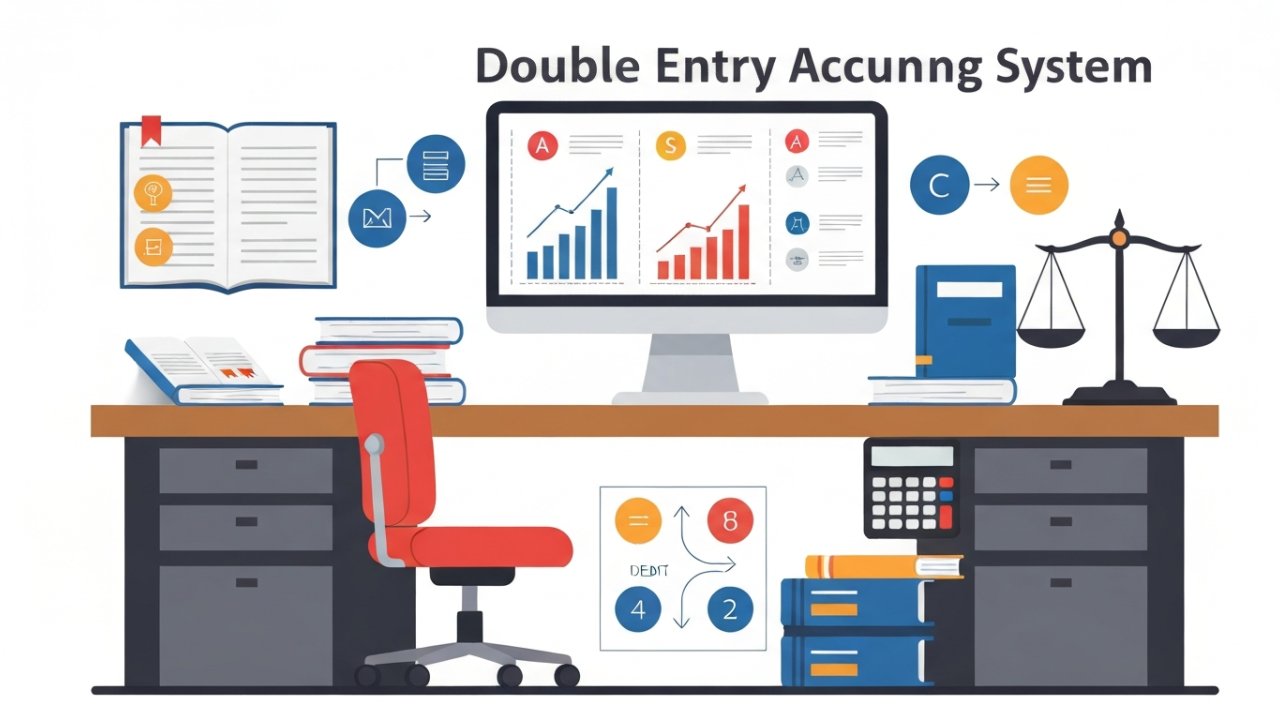
Comprehending the double-entry system is essential for anyone looking to grasp basic accounting principles.
This method requires that every transaction impacts at least two accounts, which helps maintain the balance of the accounting equation: Assets = Liabilities + Equity.
Core Principles of Double-Entry
The double-entry accounting system is vital for maintaining accurate financial records, as it requires you to record every transaction in at least two accounts. This method guarantees the accounting equation—Assets = Liabilities + Equity—remains balanced.
Each financial transaction consists of a debit and a credit for equal amounts, which helps prevent errors and improves accuracy. By capturing the dual effects of transactions, double-entry accounting provides an all-encompassing view of your company’s financial health and facilitates the preparation of accurate financial statements.
Furthermore, this system promotes accountability and transparency, making it easier for you to track financial transactions and identify discrepancies through the trial balance. Grasping these core principles is fundamental for effective accounting practices.
Benefits for Financial Accuracy
Building on the core principles of double-entry accounting, the benefits for financial accuracy become evident as you explore how this system operates. This method guarantees that every transaction affects at least two accounts, maintaining balance in the accounting equation (Assets = Liabilities + Equity).
| Benefit | Description |
|---|---|
| Error Prevention | Total debits equal total credits, reducing mistakes. |
| Accurate Records | Reliable financial statements can be prepared easily. |
| Performance Tracking | Allows in-depth analysis of profitability over time. |
Understanding these accounting basics is essential, as the fundamentals of the accounting process hinge on this system. Implementing double-entry bookkeeping means you can trust your financial data, leading to informed decision-making.
Importance of Accounting for Decision-Making

Even though many individuals may disregard the importance of accounting, it plays a vital role in decision-making for businesses of all sizes. Grasping the significance of accounting for decision-making can lead to more informed choices.
Here are a few key points to reflect on:
- Accounting provides a systematic framework for tracking financial performance.
- Regular financial reporting helps identify trends in revenues and expenses.
- Analyzing financial statements allows for evaluating profitability and overall health.
- Accurate accounting supports compliance with legal and tax obligations.
These fundamentals of the accounting process are important for maneuvering the basics of accounting and finance.
With the right data, you can make proactive adjustments to budgeting and strategy, appraise operational efficiency, and guide investment decisions effectively.
Frequently Asked Questions

How to Learn Accounting Step by Step for Beginners?
To learn accounting step by step, start by familiarizing yourself with basic terminology, like assets and liabilities.
Next, grasp the accounting equation: Assets = Liabilities + Owner’s Equity.
Study the double-entry system, where every transaction impacts at least two accounts.
Then, explore financial statements like the income statement and balance sheet.
Finally, practice using accounting software to record transactions and generate reports, enhancing your comprehension of accounting principles effectively.
What Are the 5 Basic Principles of Accounting?
The five basic principles of accounting are the Revenue Recognition Principle, which states you recognize revenue when it’s earned; the Matching Principle, ensuring expenses align with related revenues; the Cost Principle, recording assets at their original purchase cost; the Full Disclosure Principle, requiring all relevant financial information for transparency; and the Objectivity Principle, emphasizing verifiable data to reduce bias.
These principles guide accurate financial reporting and improve comprehension of a company’s financial health.
How to Explain Accounting in Simple Terms?
Accounting is simply the process of tracking a business’s financial activities. It involves recording, classifying, and summarizing transactions to understand financial health.
You’ll deal with key terms like assets, liabilities, and equity, which represent what the business owns, owes, and the owner’s investment. The accounting equation—Assets = Liabilities + Equity—ensures balance.
Financial statements like the income statement and balance sheet provide crucial insights into profitability and financial status at a specific time.
[embedded content]
Can I Self Teach Myself Accounting?
Yes, you can self-teach accounting effectively. Utilize free online resources like courses and tutorials to comprehend fundamental concepts.
[embedded content]
Practice with accounting software, such as QuickBooks, to reinforce your skills in recording transactions and generating financial statements. Engaging with textbooks provides structured learning, whereas joining online forums allows you to ask questions and share insights.
Regularly applying your knowledge through practical exercises, like creating mock financial statements, improves your grasp of accounting principles.
Conclusion

In summary, comprehension of basic accounting equips you with vital skills for managing financial transactions effectively. By grasping key concepts like the double-entry system and fundamental terms, you improve your ability to assess a business’s financial health. Familiarity with financial statements and the process of recording transactions is critical for informed decision-making. In the end, mastering these principles not just aids in compliance and strategic planning but likewise cultivates sound financial management practices that can benefit any individual or organization.
Image via Google Gemini