
This post was originally published on this site.
We live in a world where people have lost their confidence and no longer trust their own decisions. Many have no faith in their judgment, making bad choices based on technology and influencers and normative pressures —undermining their esteem still more.
Low esteem crushes the trust in their judgment and forces them to rely on the judgment of others, which is often irrelevant and sometimes even harmful to their own best interests.
I’m sure you’ve found, as have I, that people become less trusting of their own judgment when:
- Superiors are present
- The facts are unclear
- The opinions expressed are impassioned
- The consequences are significant
- Normative pressures are great
- There’s an urgency to please
PTP: Propensity To Please
I’ve recognized a pathology that I call PTP: Propensity to Please. This disorder is so strong that people sacrifice their own objectives, their time, their money, even their beliefs in order to please. It nullifies their judgment to the point that they cede their control of their choices to others.
But being able to trust in your judgment will greatly heighten your self-esteem, which will reciprocate in strengthening your faith in your judgment. Judgment is the ability to make careful, successful decisions and craft effective solutions.
The greater utility and usage of esteem and judgment are to allow you to independently decide what’s best for you. Conversely, your esteem is lowered and your judgment doubted when you make decisions based on others’ metrics (or celebrity, or reputation, or looks, or claims), which will often turn out to be horrendous for you.
Did you buy a Segway, or own a pet rock, or purchase any number of ineffective over-the-counter remedies, or book a vacation that was miserable — all based on attempts to use others’ judgment instead of your own?
Empowering yourself to better trust your own judgement involves simply being proactive in assessing your options and matching them against your personal best interests. You need to possess the confidence to pragmatically examine the “upside and downside” — that is, what’s the best and worst that might occur as a result of this decision?
Low Esteem v’s High Esteem
Low esteem people invariably overestimate the downside and undervalue the upside. Your esteem provides “guiderails” to help you determine the upside and the downside, how much time to employ in investigation, what kind of critical thinking skills are required, and how to evaluate the responses you receive.
High esteem is required to judge how best to move forward, what to trust, and what to question.
Here are some ideas to consider if you believe you can improve in these areas. Keep in mind that esteem often trumps experience:
- Where did the idea or circumstance I’m confronting come from?What is the reliability of the source? Take social media for example, where people believe they can create their own reality, and will then apply confirmation bias to find and communicate only with those who agree with them. You need to understand whether the statements or ideas are empirically correct, merely opinions, or actually false.
- What issue are we really trying to solve?For example, we often hear of problems in education and the responses are to change curricula or teachers’ income or the powers of the board of education. But the fact is that kids aren’t learning and the customers here are the kids and the parents, not the teachers and not the politicians.
- What are the ramifications if we don’t completely understand and misconstrue the true dimensions of the upside and the downside?For example, when Netflix decided to raise rates for its then-rental DVD and streaming services, it lost 800,000 subscribers!More recently, the ill-conceived marketing moves of Cracker Barrell, Budweiser, and Target demonstrate the underestimates of downside.
Trust in your own judgment manifests in the world as confidence. This creates your “gyroscope” and will keep you balanced and upright as you go through life.
Author Bio
 Alan Weiss, PhD, is a consultant, speaker, and author. Through his consulting firm, Summit Consulting Group, Inc., he has worked with more than 500 leading organizations, including Merck, Hewlett-Packard, GE, Mercedes-Benz, The Federal Reserve, and the New York Times Corporation. A sought-after speaker at major conferences, he’s also published more than 60 books, many of which have been on the curricula at top business schools.
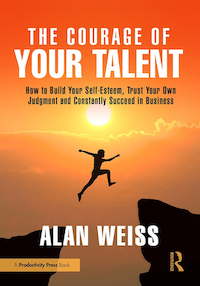
His new book is The Courage of Your Talents: How to Build Your Self-esteem, Trust Your Own Judgment, and Constantly Succeed in Business (and Life) (Productivity Press, Oct. 12, 2026). Learn more at alanweiss.com