
This post was originally published on this site.
Welsh rugby has a habit of lurching from one crisis to another; a pattern that has existed for generations but has reached unprecedented levels during the professional era.
At the heart of the latest debate is a deceptively simple question: how many professional teams can Wales realistically sustain?
The argument has largely divided into two camps. One side believes Welsh rugby can continue to support four professional clubs while the other believes the number must be reduced, perhaps to three or even two.
But beneath the arguments about geography, tradition and identity sits the one factor that ultimately dictates success in modern sport.
Money.
JOIN OUR WALES RUGBY FACEBOOK PAGE Latest news, analysis and much more
The history of professional sport is brutally consistent: money creates the conditions for success, and success creates more money.
Welsh rugby itself experienced this during the first two decades of this century. A plethora of Six Nations titles delivered unprecedented commercial success for the Welsh Rugby Union between 2005 and 2019, creating a virtuous cycle where winning strengthened the finances and stronger finances helped sustain winning.
The same principle is evident at club level across Europe.
The financial powerhouses of French rugby dominate the Champions Cup. Stade Toulousain have remained the benchmark of European excellence for years, while Leinster Rugby continue to set the standard in the United Rugby Championship.
Occasionally, a club operating on a smaller budget breaks through. Northampton Saints are one club who have demonstrated that coaching, culture and recruitment can narrow the gap but such examples are exceptions rather than evidence that money does not matter.
Of course, money alone does not guarantee success. It must be invested intelligently.
The WRU itself provides perhaps the clearest example of how badly-managed resources can undermine sporting performance.
During the period when revenues were at their highest, administrations led by chief executives Roger Lewis and Steve Phillips presided over decisions that contributed to the financial instability facing Welsh rugby today.
They will point to an area of unprecedented success for the national team but not enough money was invested into the pathway, coaching and the four professional teams.
So yes, money must be spent wisely but before money can be spent wisely, it has to exist.
And this is where Welsh rugby is falling dramatically behind its European rivals.
The financial reality
The debate over whether Wales can support four, three or two professional teams is ultimately a debate about resources. The numbers provide uncomfortable reading.
The Irish and Scottish unions own their professional teams, making direct financial comparisons difficult because their accounting practices are not structured in the same transparent manner as those of Welsh clubs.
However, available figures illustrate the scale of the challenge.
In May 2024, the IRFU announced annual funding of approximately €40 million for its four provinces which is equivalent to around £33.6 million.
The Irish system also has a heavy reliance on the private schools system, with 80% of the Ireland team which lined up against Wales in this year’s Six Nations coming from the Leinster academy.
The province of Leinster has a population of 2.8m people, whereas the population of the whole of Wales is 3m. The whole economy of Wales is worth £80 billion, while Dublin has a GDP of £157 billion.
The more buoyant Irish economy, it’s significantly higher population and the reliance on private schools means Ireland are able to produce a greater volume of professional-level players and are able to carry deeper squads with more quality.
In addition the money they generate means they can invest far more resources into coaching and facilities, which is on a different level to Wales.
One of the biggest problems Wales has is the private sector is not strong enough to compensate for the overall lack of money in Welsh society, whereas in Ireland they have huge corporate sponsors such as the Bank of Ireland and Aer Lingus.
The Welsh regions’ latest published accounts show the following WRU income for the year ending June 2025:
- Dragons: £4.933 million
- Ospreys: £5.401 million
- Scarlets: £5.020 million
Cardiff’s accounts had not been published at the time of writing, but assuming a similar WRU contribution of approximately £5 million, the comparison becomes:
IRFU provincial funding: approximately £33.6 millionWRU regional funding: approximately £20 million
The significance is clear. The IRFU believes each of its four professional teams requires around £8 million annually in central funding to compete. The WRU is attempting to make four regions competitive with roughly £5 million each.
That is not a level playing field. It is a financial disadvantage before a match has even been played.
Those who argue Wales cannot afford four professional teams point to these figures as evidence. They have a compelling case. The WRU recorded a loss in the year ending June 2025 and does not have unlimited funds available to distribute.
The income gap beyond Union funding
Central funding is only one part of a professional rugby club’s finances. The next major source of income is broadcast and competition revenue.
For the United Rugby Championship and EPCR competitions, each Welsh club received approximately £2.037 million.
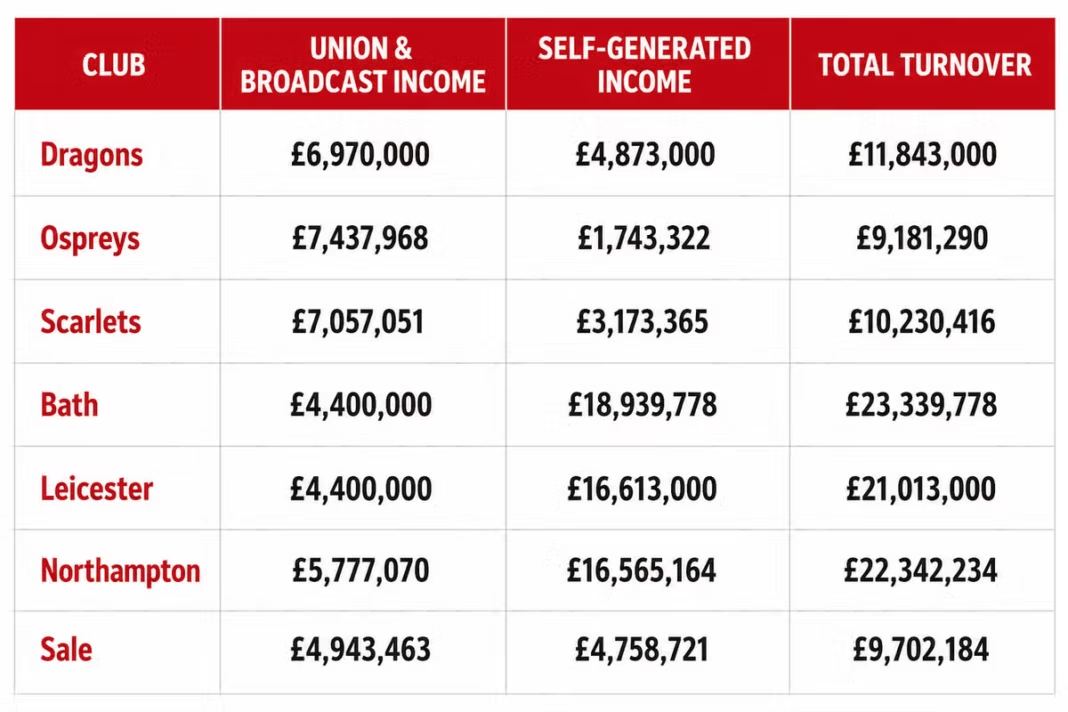
Combined with WRU funding, this provides guaranteed annual income of roughly £7 million before clubs generate their own commercial revenues through ticket sales, sponsorship, hospitality and facility use.
Those self-generated revenues reveal another significant weakness.
Comparing the Welsh regions with English Premiership clubs who operate under the same currency and accounting environment, and who could potentially become future league partners, highlights the scale of the challenge.
It is clear Wales would be better served in the Gallagher Prem than staying in the URC.
Cardiff have not been included in this comparison because, unlike the other regions, they are owned directly by the WRU, making their financial position less directly comparable.
It is important to remember that turnover is income, not profit. Every club listed spent more than its turnover during the accounting year and therefore recorded a loss.
The crucial difference is that many of Welsh rugby’s competitors have owners prepared and able to invest additional money beyond their generated revenues. The financial gulf is therefore even larger than the turnover figures suggest.
Sale Sharks provide an interesting comparison because they are arguably the English club most comparable to a Welsh club commercially. Yet their owner allowed the club to spend around £8 million more than it generated during the year in question.
Europe’s financial divide
The French clubs operate in an entirely different financial universe. Differences in taxation and economic structures make direct comparisons imperfect, but the scale remains revealing.
The smallest Top 14 club in 2025 was Perpignan, with turnover of approximately €22.6 million (£19.3 million). That means even the smallest French club was around twice the size of the largest Welsh region.
The average Top 14 club generated turnover exceeding €40 million.
In other words, the average French professional rugby club is approximately four times the size of Wales’ strongest regions.
South Africa presents another interesting comparison. The domestic salary cap is approximately R85 million, equivalent to around £3.85 million. On paper that appears modest, but comparisons must take into account economic differences, including the higher cost of living in Wales compared with Cape Town.
Again, the conclusion is unavoidable: Welsh rugby’s professional teams are financial minnows competing against substantially wealthier opponents.
The consequences
This is not simply about balance sheets. It directly impacts performance.
The best coaches, the best analysts, the best preparation, the best medical teams, the best conditioning programmes, the best facilities and the best player development systems all require investment.
Money does not guarantee success but a lack of money makes sustained success impossible.
Look at the facilities available to clubs such as Bath and Bristol Bears, whose training base would not be out of place in football’s Premier League.
Look at the academy structures, player development pathways and wages available to young talent. It becomes much easier to understand why some of Wales’ brightest prospects choose to leave.
In the Gallagher Premiership clubs are often able to offer senior academy contracts that are considerably more lucrative than those available in Wales.
With Welsh academy deals typically worth around £5,000 a year, compared with £18,000–£20,000 across the Severn Bridge, the financial disparity has long been decisive.
To their credit the WRU are planning to invest £28m into the pathway over the next five years and are aiming to bring back a national academy.
They claim under the new pathway they will be able to financially match what is offered to academy players in England.
The reason so many Welsh players now represent clubs outside Wales is not complicated.
Money.
The challenge facing Welsh rugby is therefore not merely deciding whether there should be four professional teams, three or two.
The deeper question is whether Wales can create enough financial strength to make any number of teams genuinely competitive.
The evidence suggests it cannot currently do so with four.
The figures demonstrate that Welsh regions are significantly behind their English and French counterparts commercially, while non-URC competitors generate far greater independent revenues.
Welsh rugby needs to increase income, improve how existing resources are allocated and concentrate investment from regional age-grade structures through to the national team.
The uncomfortable conclusion is that Welsh rugby must reduce its professional footprint and find a model capable of creating genuine competitiveness.
Four teams can be retained but not at a level where they can be truly competitive, especially playing within the URC.
There are many who would prefer Welsh rugby to avoid structural upheaval and preserve the system as it exists today. That instinct is understandable, given the history, identity and traditions attached to the game. But sentiment cannot override financial reality.
Welsh rugby simply cannot afford to stand still.
The WRU must reduce unnecessary costs, improve governance and ensure that every pound available is invested where it delivers the greatest impact.
But even the most disciplined approach to spending is unlikely to close the gap that now exists between Welsh rugby and its European rivals.
The uncomfortable truth is that efficiency alone will not solve a problem of scale.
The game does not merely need to spend better, it needs a model capable of generating significantly greater resources.
Follow all of our channels to ensure you stay up to date with the latest Welsh rugby news. Sign up to our free daily newsletter here and our WhatsApp channel here for all the breaking news.