
Profound and Peec AI are two of the most frequently compared tools in the AEO category right now, and the decision isn’t so straightforward. The two platforms take different approaches to data collection, pricing, and what happens after you read a visibility score.
This article reviews both and provides a straight head-to-head across the most important decision-making criteria: engine coverage, data methodology, analytics depth, integrations, pricing, and what a team can actually do once a gap surfaces.

If you’re also considering options that tie AI visibility to your CRM and content workflow, I’ll introduce HubSpot AEO as a third path worth evaluating, though the Profound versus Peec AI comparison comes first.
Table of Contents
Profound vs Peec AI: At a Glance
Here’s how Profound, Peec AI, and HubSpot AEO stack up on the most important deciding criteria. Values reflect each vendor’s published information as of October 2026; if you want a baseline before committing to any tool, the free AI Search Grader scores how answer engines currently represent your brand.
Fit Summaries
- Profound fits enterprise teams that need broad engine coverage and log-level crawler data and can absorb custom Enterprise pricing to get it.
- Peec AI fits marketing teams and agencies that want focused, multi-country visibility tracking with unlimited seats at a lower entry price.
- HubSpot AEO fits teams that want an affordable entry into AEO with recommendations they can act on inside HubSpot.
Not sure where you stand today? HubSpot’s free AI Search Grader scores how ChatGPT, Perplexity, and Gemini currently describe your brand.
What Each Platform Is Built For
Profound, Peec AI, and HubSpot AEO all track answer-engine visibility, but each is built around a different job.
Profound: Enterprise
Core purpose: Profound sits at the enterprise-grade end of the category. It pairs deep AI-search analytics with content execution, positioning itself as what the company calls a “read/write” system for AI search rather than a reporting dashboard alone.
Typical buyer: Profound’s typical buyer is an enterprise growth team, a dedicated AEO strategist, a brand or PR lead, or an agency running large client portfolios.
Workflow depth: Profound’s workflow goes deep with server-side bot-crawl tracking, consumer prompt-demand research, up to nine tracked engines on Enterprise, and drag-and-drop agents that connect to enterprise CMS platforms.
Team maturity: Profound’s depth suits mature organizations that run formal AEO programs and need log-level crawler data plus enterprise security controls like SOC 2 Type II, HIPAA, and SSO.
Peec AI: Lean and Mid-Market
Core purpose: Peec AI answers the “what is Peec AI” question simply: It is a focused AI search analytics tool that tracks brand visibility, average position, sentiment, share of voice, and source citations across AI models, with a content optimization workspace for revising individual pages.
Typical buyer: Peec AI’s typical buyer is a lean marketing team, an SEO or content manager, or a growth agency that wants clean multi-country tracking without paying per seat.
Workflow depth: Peec AI’s workflow centers on measurement: Teams pick engines, tag prompts by funnel stage or persona, and read visibility trends from its dashboards. Any page an Action flags can then be reworked in a built-in editor.
Team maturity: Peec AI fits lean to mid-sized teams and agencies that already own their content workflow elsewhere and want an affordable, flexible reporting layer on top.
Where HubSpot AEO Fits in This Comparison
HubSpot AEO is the affordable entry point here. Starting at $50/month, it tracks how ChatGPT, Perplexity, and Gemini describe your brand and returns prioritized recommendations for closing the gaps it finds.
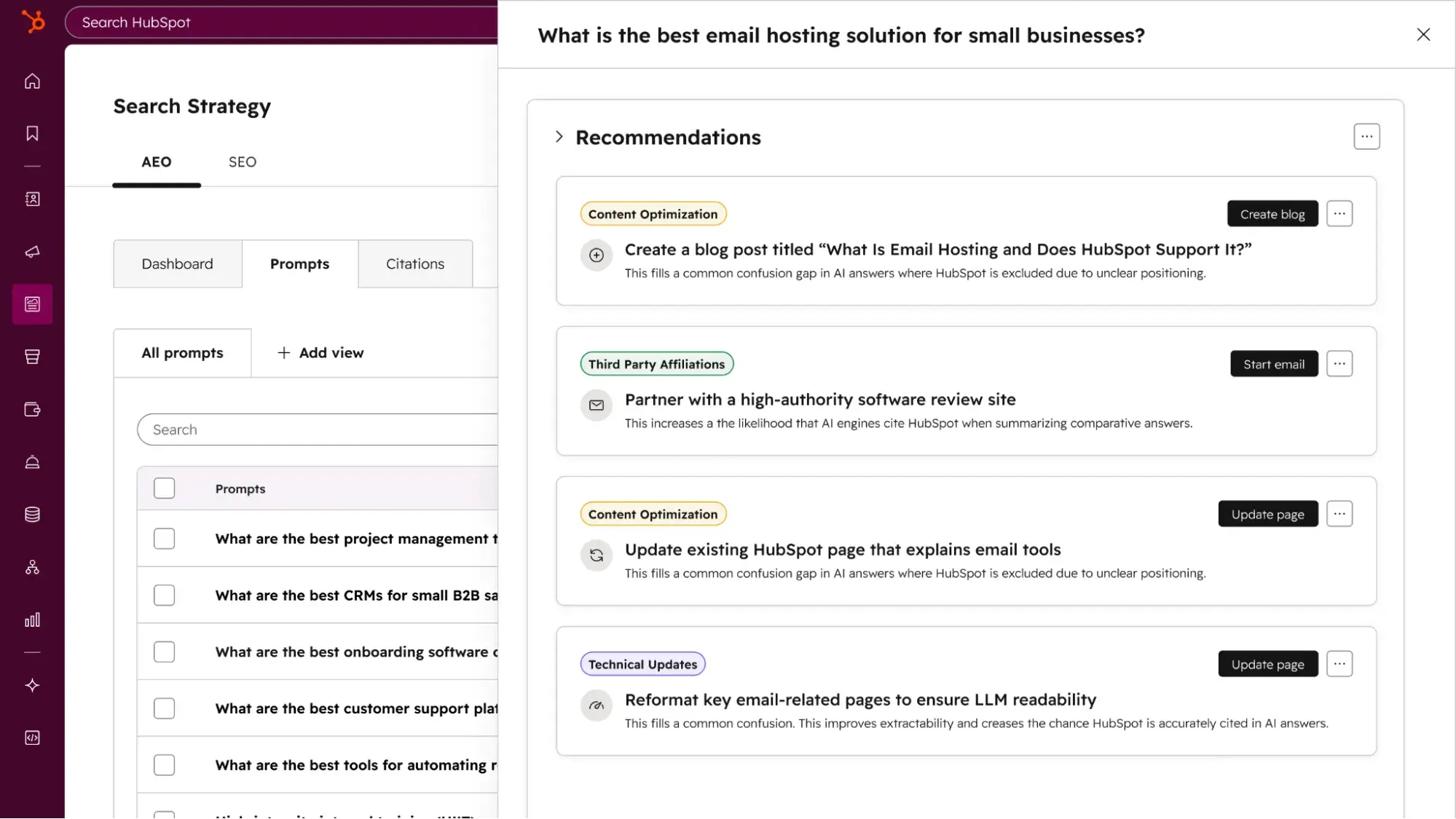
What separates it from a measurement-only tool is context: AEO in Marketing Hub connects to HubSpot Smart CRM so prompt suggestions reflect your own contacts, deals, and target segments rather than generic category guesses, and marketers can act on those recommendations by drafting and publishing content in the same platform through content agent. For a team already running marketing in HubSpot, that connection makes AEO in Marketing Hub a stand-out choice.
Profound vs. Peec AI: Data Coverage and Methodology
All three tools report AI visibility, but they collect it differently.
Profound queries live, consumer-facing answer engines directly rather than static model APIs, capturing the real-time browsing behavior those APIs miss. It layers on Agent Analytics, server-side trackers installed at the CDN or hosting level (Cloudflare, Vercel, AWS, Fastly) that log AI crawler user-agents and cross-check visitor IPs against published crawler ranges to filter spoofers. A licensed consumer-panel dataset then estimates AI search volume and intent.
Peec AI takes the opposite stance: It avoids APIs entirely and runs browser automation against each engine’s live web interface as a logged-out user, on the reasoning that API responses are often sanitized and diverge from what people actually see. It captures crawler activity through CDN integrations or raw log uploads.
Coverage and refresh cadence follow those choices. Profound scales engines by tier (see the table above) and runs prompt checks daily, surfaces crawler logs in near real time, and refreshes prompt-volume data weekly. It supports any language but gates multi-region and multi-language tracking to Enterprise. Peec lets you choose engines modularly, queries each one from localized IPs, and samples each model once every 24 hours. It doesn’t charge per country, but it caps countries by plan (1 on Starter, 3 on Pro and Advanced, unlimited on Enterprise), while languages are unlimited on every plan.
Each approach has limits. Profound’s only self-serve option for brands is a 7-day free Trial with a fixed prompt set, while ongoing tracking, API, and SSO access sit behind Enterprise contracts. Peec AI suggests passage-level rewrites and lets you edit a draft in its workspace, but it doesn’t publish; you export the content to your CMS. API and SSO are reserved for Enterprise, and add-on fees are $35 to $165 per month (on monthly billing) for engines beyond the base three.
Before treating two visibility scores as equivalent, ask each vendor:
- Are prompts run through APIs, browser automation, or live consumer sessions?
- How many times a day is each prompt sampled, and how is daily variance smoothed?
- Are queries executed from localized IPs in your target countries?
- Does the tool separate pages a model read to synthesize an answer from URLs it actually cited?
- Is “visibility” mention presence, ranking position, or competitive share of voice?
How HubSpot AEO compares: HubSpot AEO tracks a fixed set of three engines (ChatGPT, Perplexity, and Gemini). It runs those prompts daily from country-specific IPs that match your target market and logs exact daily answers and citation URLs rather than modeled estimates.
Profound vs Peec AI: Analytics and Reporting
Profound and Peec AI both report sentiment, share of voice, ranking, and citations. But there’s nuance in how they report and what you do with the insights after.
Sentiment
- Profound sorts mentions into positive, neutral, or negative inside its Answer Engine Insights module and flags hallucinations where models state false claims about you.
- Peec AI scores sentiment 0 to 100 per engine and pulls the specific attributes models attach to your brand, linking incorrect claims back to their source URL.
Share of Voice and Ranking
- Profound tracks mention-based share of voice plus domain-level citation share against custom competitor sets, and maps which domains get co-cited together.
- Peec AI reads share of voice as your share of brand mentions versus competitors and adds Average Position, the ordinal rank of your brand within an answer.
Citation Tracking
- Profound classifies cited URLs by type (owned, competitor, earned, PR, social, institution) and names the publishers driving citations in your category.
- Peec AI separates sources a model “used” to build an answer from those it actually “cited,” at both domain and URL level.
Dashboards, Insights, and Exports
- Profound splits metrics across modules, compiles priorities into an Opportunities dashboard, and offers a natural-language Ask query; CSV and JSON exports and the REST API on Enterprise only.
- Peec AI keeps one focused dashboard and an Actions framework that ranks site-audit, owned, and earned fixes on a relative impact scale; CSV on every tier, a Looker Studio connector on Advanced, and an MCP server on all paid plans.
What Stays Manual
- Profound drafts content through its Agents, but PR outreach and multi-channel publishing still need a strategist.
- Peec AI’s editor proposes rewrites for pages tied to an Action; publishing the result and running outreach happen outside Peec.
What HubSpot AEO reports: HubSpot AEO tracks visibility daily across ChatGPT, Perplexity, and Gemini, reporting a Brand Visibility Score, sentiment, share of voice, and citations across key source channels, then returns prioritized recommendations. On its own, HubSpot AEO works from the brand and domain details you enter. In Marketing Hub Professional and Enterprise, AEO grounds those suggestions in Smart CRM data and links them to content agent for drafting and publishing directly inside HubSpot.
Profound vs. Peec AI Integrations and Security
Integrations determine how well an AEO tool fits into your existing tech stack, and security controls determine how safely it handles your data. Here’s how Profound and Peec AI compare on both.
APIs and Programmatic Access
- Profound offers a REST API, Python and JavaScript SDKs, and an MCP server, all reserved for Enterprise.
- Peec AI gates its REST API to Enterprise but includes its MCP server on every paid plan.
SSO and Permissions
- Profound supports SAML 2.0 and OIDC SSO (Okta, Microsoft Entra ID, Google Workspace) with role-based access control, Enterprise-only.
- Peec AI also offers SAML/OIDC SSO on Enterprise only.
BI Connectors and Exports
- Profound exports CSV and JSON on Enterprise only and ships native integrations for Contentful, Vercel, Sanity, WordPress, and GA4.
- Peec AI includes CSV on every plan and a Google Looker Studio connector on Advanced and Enterprise.
CDN and Log Tracking
- Profound’s Agent Analytics connects to Cloudflare, Vercel, CloudFront, Fastly, Netlify, Akamai, Google Cloud CDN, and WordPress.
- Peec AI captures bot logs through Cloudflare, Vercel, and WordPress.
Compliance
- Profound holds certified SOC 2 Type II and HIPAA compliance, with encryption at rest and in transit.
- Peec AI is GDPR-compliant but publishes no SOC 2 Type II or HIPAA certification.
Read more about AI data protection best practices.
Required Feature vs. Tier Checklist
How AEO in Marketing Hub compares: Marketing Hub Enterprise includes SAML-based single sign-on, and HubSpot maintains a SOC 2 Type II report plus GDPR features for recording consent and erasing contact records. AEO in Marketing Hub draws on Smart CRM data and hands recommendations to content agent, which drafts blog posts your team can review and publish in the same HubSpot account.
Profound vs. Peec AI Pricing and Tier Gating
Profound quotes brands individually after a free trial and charges agencies per client workspace, while Peec AI scales by prompt volume and country.
Profound
- Trial, free for 7 days: 50 preset prompts run daily across ChatGPT, Gemini, and Google AI Overviews, limited AI Marketer credits, 1 region and 1 language, and unlimited seats. Exports, API access, and support are not included.
- Agency Growth, $99/mo base + $399/mo per client workspace: 10 pitch workspaces a month, 5 seats, and 100 prompts per client workspace across ChatGPT, Perplexity, and Google AI Overviews.
- Enterprise (custom): up to 9 engines, a custom prompt volume, custom languages and regions, CSV/JSON exports, API access, SSO/SAML, SOC 2 compliance, and dedicated support options.
Peec AI
- Starter, $95/mo: any 3 of 6 engines, 50 prompts, 1 country, and unlimited seats.
- Pro, $245/mo / Advanced, $495/mo: raise prompts, projects, and countries (up to 3); Advanced adds a Looker Studio connector.
- Enterprise (custom): all engines, custom prompt volume, API, and SSO.
- Extra engines run roughly $35 to $165/mo (billed monthly) depending on tier, and every plan starts with a free trial.
HubSpot AEO
- $50/mo ($45/mo billed annually): 25 prompts daily across ChatGPT, Perplexity, and Gemini, 2 seats, and a 28-day free trial with no credit card.
- Purchase additional prompts as needed, with no cap.
- Included at no extra cost in Marketing Hub Professional (25 prompts, 3 seats) and Enterprise (50 prompts, 5 seats).
Company maturity: Profound is the funding leader. Its $180M Series D in September 2026 valued the company at $1.8 billion, up from $1 billion after its $96M Series C that February. Peec AI is earlier stage but well-backed, with a $21M Series A in November 2025 (roughly $29M total).
Actionability Beyond Dashboards
Once a tool surfaces a visibility gap, the workflow to close it varies by platform.
How do I turn visibility gaps into a content plan?
- Profound: Profound Agents draft LLM-formatted content and push it into a connected CMS like Contentful, Sanity, or WordPress, with a human review step.
- Peec AI: Each content optimization Action opens in an in-app editor. Teams apply or dismiss suggested rewrites, ask an AI Agent for edits or let an MCP-connected assistant work through them, then copy or download the revised page.
- AEO in Marketing Hub Professional and Enterprise: Recommendations connect directly to content agent, which drafts posts grounded in Smart CRM data and brand voice for review and publishing inside HubSpot.
After making changes, begin measuring the next day, but compare against a baseline over several weeks before judging impact.
What is the best way to connect AI visibility to pipeline?
Separate web sessions from zero-click mentions:
- Profound logs AI crawler visits server-side and correlates them with referred traffic in GA4 or a data warehouse.
- Peec AI streams scores into BI tools via Looker Studio, its API, or MCP.
- HubSpot AEO (Professional and Enterprise) classifies AI referral traffic as a session-level source in Smart CRM; Marketing Hub Enterprise multi-touch attribution can then tie converting sessions to deals.
Limitation: No tool ties a zero-click AI mention to a specific deal. Treat zero-click visibility and closed-revenue attribution as related, not identical.
How can my team act without adding more tools?
First, take a look at your existing infrastructure. Then consider which of the following AEO tools best fits into that tech stack for better consolidation. Here are my recommendations:
- AEO in Marketing Hub keeps tracking, CRM-informed prompts, briefs, drafting, and attribution inside Marketing Hub, so there is no separate contract or login to manage.
- Ideal for: Teams already working in the HubSpot ecosystem
- Peec AI pairs measurement with page-level editing and streams data into the tools you already run through MCP, Looker Studio, or its API.
- Ideal for: Lean teams and agencies with an established publishing setup who want optimization suggestions attached to their tracking data
- Profound brings its own enterprise workspace while connecting natively to headless CMS setups.
- Ideal for: Large teams that want to keep their existing headless infrastructure
Verdict by Team and Use Case
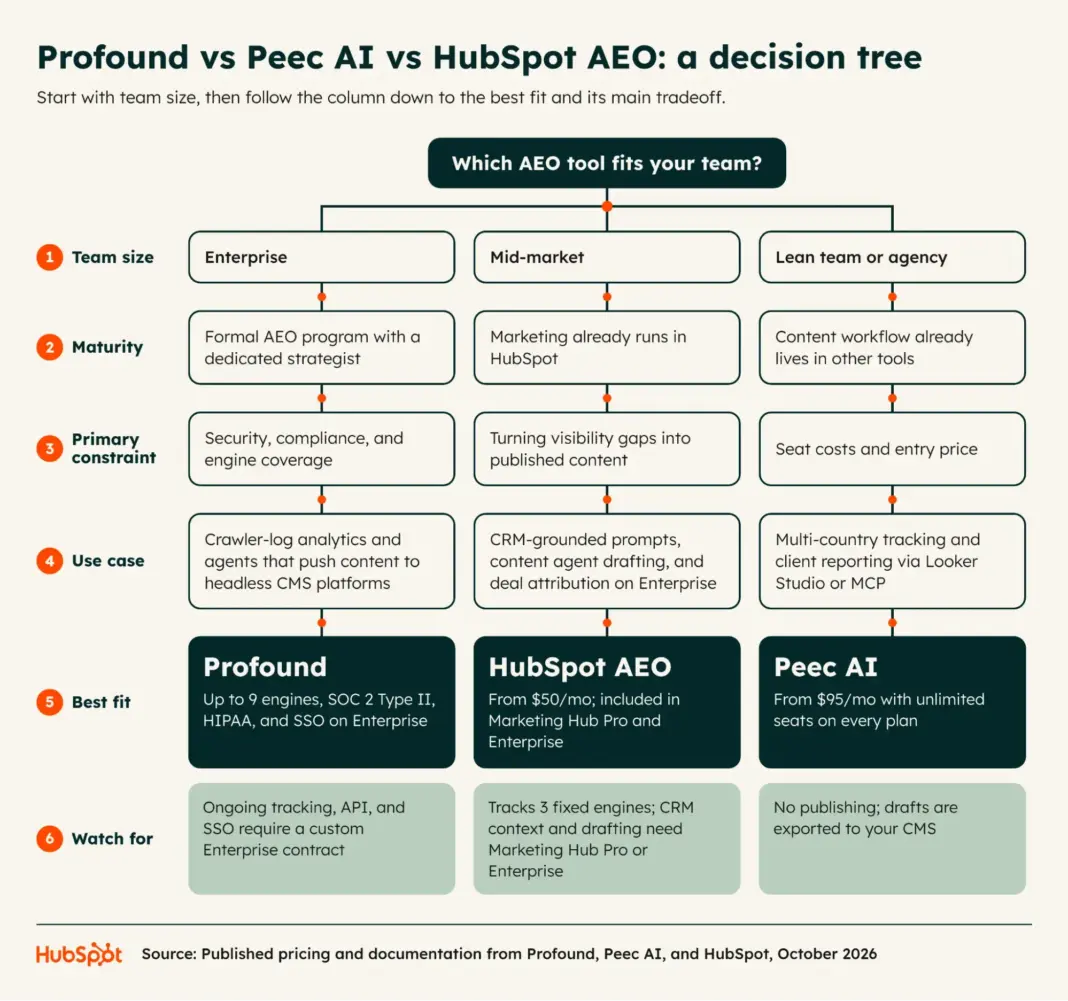
The right AEO tool depends on your organization’s stage, existing stack, and biggest operational constraint. Here’s how Profound, Peec AI, and HubSpot AEO stack up.
Enterprise and Security-Led Teams: Profound
Profound offers coverage of up to nine answer engines on Enterprise, log-level crawler analytics, and the compliance posture regulated teams need: SOC 2 Type II, HIPAA, and SAML/OIDC SSO. Its Agents draft and push content into headless CMS platforms like Contentful and Sanity.
The tradeoff: cost and complexity. Ongoing tracking beyond the 7-day Trial, the REST API, and expanded agent credits all require an Enterprise contract.
Mid-Market and Speed-Focused Teams: HubSpot AEO
AEO in Marketing Hub closes the distance between insight and action for teams already using HubSpot. In Marketing Hub Professional and Enterprise, AEO grounds prompt suggestions in Smart CRM data and links recommendations to content agent for drafting directly inside HubSpot. Marketing Hub Enterprise multi-touch attribution can then connect those AI-referred sessions to closed deals.
The tradeoff: scope. HubSpot AEO tracks a fixed three engines (ChatGPT, Perplexity, and Gemini) and does not monitor Google AI Overviews, Claude, or Copilot. On its own plan, it works without CRM context or built-in publishing.
Agencies and Multi-Stakeholder Teams: Peec AI
Peec AI includes unlimited seats on every plan, so agencies can add client teams, strategists, and freelancers without per-seat costs. It delivers clean multi-country visibility, sentiment, and citation tracking, and streams results via its Looker Studio connector and MCP server.
The tradeoff: no publishing layer. Drafts revised in Peec AI leave the tool as HTML or plain text, and PR and distribution remain manual.
Before you sign, pressure-test the fit:
- Profound: Will your team use crawler-log tracking and CMS agents, or pay an enterprise premium for reporting alone?
- AEO in Marketing Hub: Is the goal to connect visibility to CRM deals and publishing in HubSpot, or to cover niche engines?
- Peec AI: Does your own CMS already handle publishing, and do unlimited seats outweigh an all-in-one content workflow?
Why Consider HubSpot AEO for Pipeline-Linked AEO
If you’ve weighed Profound versus Peec AI and still don’t feel confident in either, HubSpot offers two AEO paths. HubSpot AEO handles measurement and recommendations without requiring any other HubSpot subscription. AEO in Marketing Hub Professional and Enterprise is built for teams whose harder problem is turning that measurement into published content and traceable pipeline.
When CRM Context and Connected Execution Matter
These three conditions point to AEO in Marketing Hub (available on Professional and Enterprise), since HubSpot AEO on its own suggests prompts from the company, competitor, and industry details you enter:
- You want prompts drawn from real business context. AEO in Marketing Hub builds its prompt list from your CRM records, so tracking reflects your contacts, campaigns, and content.
- You want to fix gaps without switching tools. Marketers can send a blog recommendation to content agent, which writes a draft matched to your brand’s tone inside the same account.
- Leadership wants AI search tied to revenue. Marketing Hub shows AEO data beside campaign metrics, and Marketing Hub Enterprise adds revenue attribution reporting that credits deals to the touches behind them.
What HubSpot AEO Provides
Every purchase path shares the same core: HubSpot AEO tracks ChatGPT, Perplexity, and Gemini daily, reports a Brand Visibility Score, sentiment, share of voice, and citation sources, then returns prioritized recommendations.
Which Capabilities Require Which Tier
- HubSpot AEO ($50/mo): full visibility tracking, citation analysis, and recommendation briefs, grounded in the domain details you provide. No CRM context or built-in content execution.
- AEO in Marketing Hub Professional: adds Smart CRM-grounded prompt suggestions and content agent drafting, included at no extra cost.
- AEO in Marketing Hub Enterprise: adds multi-touch attribution plus higher prompt and seat limits.
HubSpot AEO measures like Profound and Peec AI, but its CRM-connected execution and revenue attribution are available only inside Marketing Hub Professional and Enterprise.
Want to know how AI answer engines describe your brand today? Try HubSpot AEO free for 28 days. Your free trial checks 25 prompts a day across ChatGPT, Perplexity, and Gemini — no credit card needed.
Frequently Asked Questions About Profound vs. Peec AI:
How can I verify regional AI visibility accuracy?
Run the same prompt several times through a VPN set to your target country, either logged out or with memory and personalization turned off. Repeat across several days, note the date and time of each check, and compare the results with the tool’s data for the same prompt, engine, and dates. Look for directional agreement in brand mentions and citations rather than exact matches, since AI responses vary. Ask vendors how they simulate location, which regions they support, how often each prompt runs per region, whether results are aggregated or smoothed, and whether you can inspect the underlying responses.
What’s the fastest way to show leadership the value of AEO?
Pick one prompt that maps to a segment leadership already tracks, whether a top persona, flagship product, or key competitor, and chart its weekly visibility trend alongside AI referral traffic. A single moving number is easier to defend than a full AI marketing analytics report. Teams on HubSpot Marketing Hub Enterprise can connect AI-referred sessions to deals through multi-touch attribution.
When should we upgrade tiers for more engines or seats?
Upgrade for engines when referral data or audience research shows buyers using that engine, or when a manual spot check turns up competitors there. Upgrade for seats when collaborators need their own access, or you’re managing client reporting. For Profound, Peec AI, and HubSpot AEO, upgrading for prompt volume makes sense when your current allowance can’t cover the personas, products, and competitors your tracking strategy requires.
How do I avoid “dashboard fatigue” with AEO?
Assign one person to own AEO reporting and agree on a review cadence before pulling any metrics. Track as many prompts as your strategy requires, but review them by segment or topic rather than one at a time, and start each review with the tool’s prioritized output: Peec AI’s Actions ranks recommended fixes by expected impact, and Profound’s AI Marketer surfaces suggested opportunities for your brand. React to a metric only when it crosses a threshold you defined before the review.