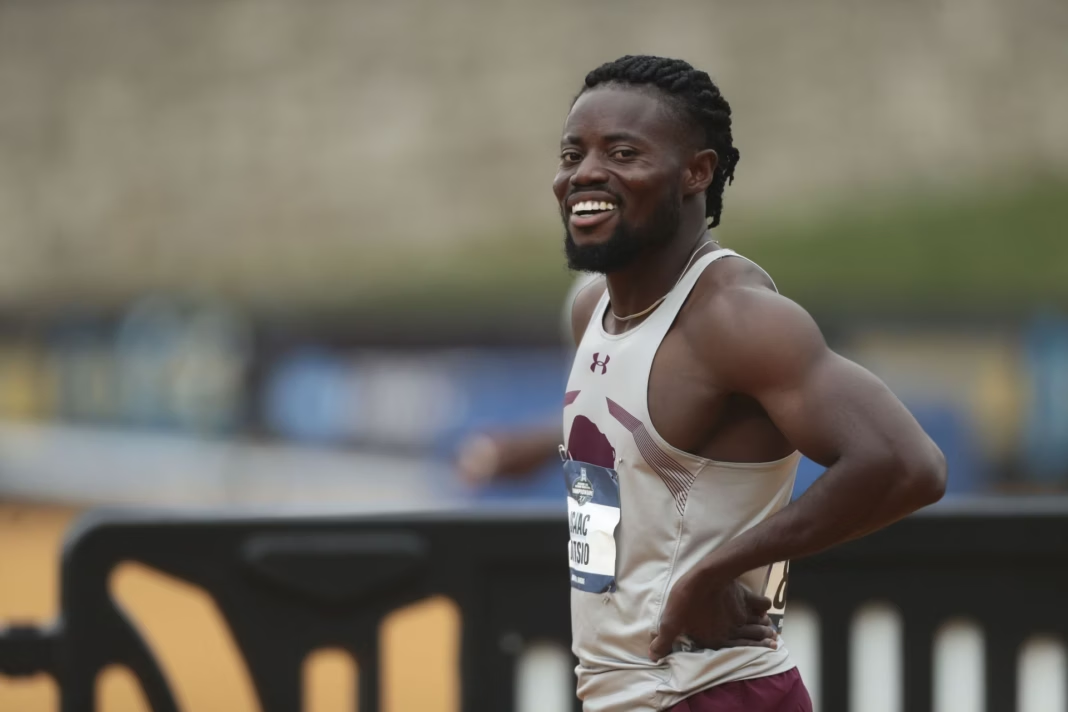


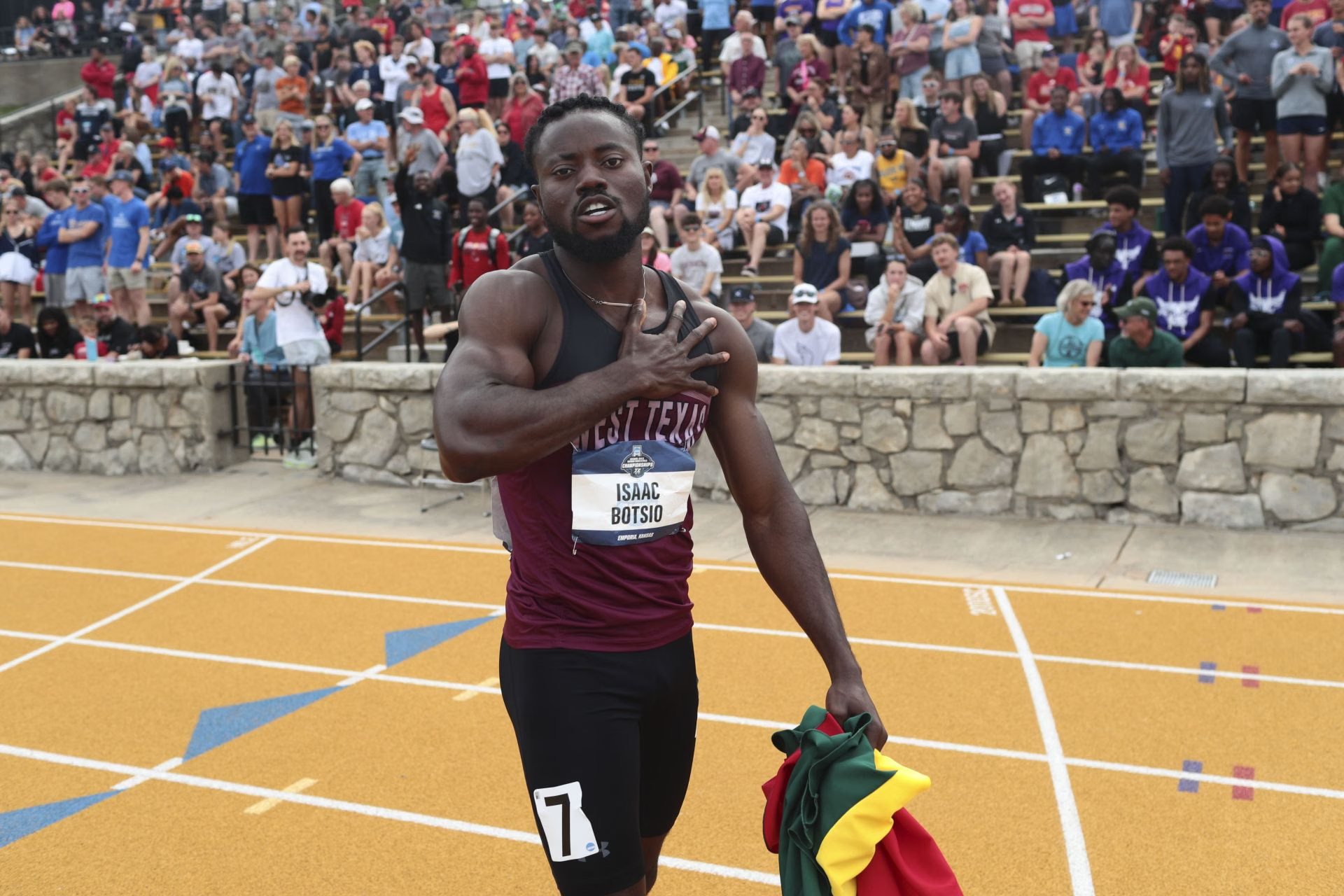
Isaac Botsio, a Ghanaian Olympic sprinter and seven-time NCAA Division II national champion, completed a remarkable collegiate career at West Texas A&M University in 2026. Botsio, 26, made history by winning three consecutive NCAA Division II outdoor 100m national titles from 2024 to 2026, and also holds NCAA Division II titles in the 4x100m relay (2023-2025) and the indoor 60m (2023).
Raised in Ahinkofikrom in Sekondi-Takoradi, Botsio’s journey to the competitive stage was long: after finishing high school, he trained for three years at Essipong Stadium before receiving a grant to study and compete. After arriving in the USA, he won the African Championships as part of a 4x100m relay team, posted an all-conditions 100m time of 9.90 seconds (+2.2 m/s), represented Ghana at the Paris 2024 Olympics, and earned a nursing diploma from West Texas A&M University.
In an exclusive interview with Sportskeeda, Isaac Botsio discussed the scheduling problems that Ghanaians in the NCAA have to go through, being alongside record holder Benjamin Azamati, seeing Christian Coleman at the Paris Olympics, and his ultimate goal of consistently running below 10 seconds on the way to the podium at the 2028 Olympic Games in Los Angeles.
Isaac Botsio overcoming grassroots obstacles in Ghana, Essipong Stadium solitude, and the West Texas A&M sacrifice
1. Would you attribute your early challenges and breakthroughs to your background growing up in Ghana?
Isaac Botsio: Yes, to some extent, especially after graduating from high school and spending three years at home. I dedicated all of that time to track and field as a young athlete, chasing my dreams. Growing up in Ghana, access to resources, equipment, and competitive opportunities in athletics was very limited.
However, those obstacles shaped my mentality, discipline, and determination. Instead of allowing my background to limit me, I used it as motivation to work harder and pursue my goals.
2. What were your biggest personal sacrifices and cultural adjustments when moving from Ghana to West Texas A&M University?
Isaac Botsio: Leaving my family and adapting to an entirely new environment were among my biggest sacrifices. After graduating high school, I saw my classmates elevating—some were entering universities while others secured employment. Seeing that didn’t discourage me from chasing my ambitions.
I still remember the lonely journey training at Essipong Stadium with my local coach, Emmanuel Budu, because my dream was always to travel abroad and make a difference. That dream came true at West Texas A&M University. Once at WT, balancing rigorous academics, collegiate athletics, and personal responsibilities was challenging. The experience taught me independence, resilience, and the importance of stepping outside my comfort zone to achieve more.
Isaac Botsio on winning three consecutive NCAA 100m crowns and the post-collegiate scheduling gap
3. What was your mindset behind winning three consecutive NCAA Division II 100m national titles from 2024 to 2026?
Isaac Botsio: My mindset was to stay hungry and never become comfortable with success. Every single season presented new challenges, so I focused on attacking my weaknesses and maintaining year-round consistency.
Winning my first national title was special, but defending it twice required even greater discipline, preparation, and mental toughness. I’m deeply grateful to West Texas A&M for this opportunity, as well as my coaches—Matthew Stewart, Gibson, and Elorm Amenakpor—along with our athletic trainers at WT for standing by my side throughout these years and ensuring I was ready when it mattered most.
4. How would you compare the demands of NCAA competition to racing on the senior international circuit?
Isaac Botsio: The NCAA is highly competitive and played a massive role in my tactical and technical development. However, international competition is on another tier because you are lining up directly against the world’s absolute best athletes.
Representing Ghana on that level comes with far greater national responsibility and public expectations. As a result, mental preparation, emotional poise, and flawless race execution become even more critical when you step onto the international stage.
5. What stands out to you about Jordan Anthony’s rapid rise, and what structural changes must Ghana make to ensure its sprinters compete consistently?
Isaac Botsio: Jordan Anthony‘s rapid improvement demonstrates what natural talent, discipline, and a strong, well-funded training environment can produce. I actually reached out to him on Instagram—he’s a great guy.
Ghana possesses tremendous raw sprinting talent, but we urgently need modern facilities, high-quality coaching, structured financial support, and consistent international exposure to compete regularly with the world’s elite. Most of Ghana’s rising sprint stars are competing in the NCAA. What hinders us most is that we don’t get any competitive meets to run after the NCAA season ends and before major international championships. There must be a deliberate, structured competitive calendar built around this gap.
6. What systemic changes are necessary for Ghana to consistently challenge for individual global medals on the track?
Isaac Botsio: I believe we need stronger grassroots development, better training facilities, certified coaching education, and consistent financial investment in athletes.
We must also provide our sprinters with more regular international competition opportunities. Ghana has the talent, but turning that talent into world-class, podium-level performances requires long-term institutional commitment and the right resources.
Team synergy in the 4x100m relay, block mechanics, and Paris Olympic lessons
7. How vital is team synergy when competing in the 4x100m relay for Ghana?
Isaac Botsio: Based on my experience, team chemistry is paramount because simply having four fast athletes does not automatically guarantee success. Trust, verbal communication, and efficient baton exchanges make the difference between a medal and a disqualification.
We focus heavily on understanding each other’s stride patterns and practicing baton exchanges consistently, because every fraction of a second matters. Our hard work is being recognized on the global stage, and I believe in a few years Ghana will be a global champion and the talk of track and field.
8. What do you consider your greatest technical strengths in the 100m, and what specific phases of the race are you working to refine?
Isaac Botsio: My coach and I are working intensely on my block clearance and the first two steps of my drive phase. I consider my acceleration and maximum velocity to be my main strengths.
However, we are continuously working on refining my block starts, transitioning smoothly into upright top-end speed, and maintaining efficient mechanics through the finish line. At the elite level, minor technical tweaks yield major time drops. We are still developing these adjustments, but our target times will be achieved as the season unfolds.
9. How do you manage injury risks while balancing heavy training volumes and recovery?
Isaac Botsio: We prioritize comprehensive dynamic warm-ups, posterior-chain strength work, joint mobility, structured nutrition, and adequate sleep. Recovery is just as crucial as time spent on the track, because staying healthy is the only way to deliver consistent performances. I listen closely to my body so my coaching staff can modulate training intensity and prevent soft-tissue injuries before they occur.
10. How does lining up against American and Jamaican sprinters influence your training standards?
Isaac Botsio: Competing against world-class athletes pushes me to raise my personal benchmarks. It forces me to identify technical deficiencies and motivates me to improve technically, physically, and mentally. Lining up against the best is the fastest way to progress.
Observing Christian Coleman and other top sprinters up close, I told myself there isn’t a massive physiological difference between us. From that day on, I realized that if they can achieve those world-class times, I can achieve them as well with dedicated effort.
Botsio on getting mentorship from Benjamin Azamati, Usain Bolt’s influence, and targeting LA 2028

11. Who were your primary role models growing up in sprinting?
Isaac Botsio: Benjamin Azamati is someone I look up to immensely. I watched him compete locally in Ghana before he moved to West Texas A&M, and he is like an older brother to me. He always gives me advice and technical cues whenever I need to improve.
Earlier in my development, Usain Bolt and Asafa Powell were huge inspirations because of their dominance and longevity in sprinting. Watching them motivated me to dream of representing Ghana on the world stage. My family and the people who backed me from day one—especially Fever Global Sports (FSG) for believing in my potential—have been instrumental in my journey.
12. Outside of track and field, do you follow or play any other sports?
Isaac Botsio: Yes, I love following football, especially major international tournaments. I appreciate the team dynamics, passion, and tactical discipline involved. Every sport reinforces fundamental principles of leadership, mental toughness, and resilience.
13. What is your message to young, aspiring athletes across Ghana and the African continent?
Isaac Botsio: Never allow your background or current circumstances to dictate the ceiling of your dreams—look at my journey as an example. Success demands strict discipline, patience, personal sacrifice, and consistency.
My journey from Ahinkofikrom to becoming a three-time NCAA Division II 100m champion and an Olympian proves that with determination and the right opportunities, anything is possible. Believe in your abilities, never give up, and stay hungry.
14. What are your performance targets for the Los Angeles 2028 Olympic Games and the upcoming seasons?
Isaac Botsio: My primary objective is to cement myself among the premier sprinters in the world, consistently break the 10-second barrier, and lower my wind-legal personal best below 9.90 seconds.
For the Los Angeles 2028 Olympics, my goal is to stand on the podium as an individual medalist and help Ghana capture a global medal in the 4x100m relay. Ultimately, I want to build a lasting legacy that inspires the next generation of Ghanaian athletes to believe that they can reach the pinnacle of world athletics. Greatness is not determined by where you start, but by the discipline, sacrifice, and determination you bring every day.
Edited by Shyam Kamal