
This post was originally published on this site.
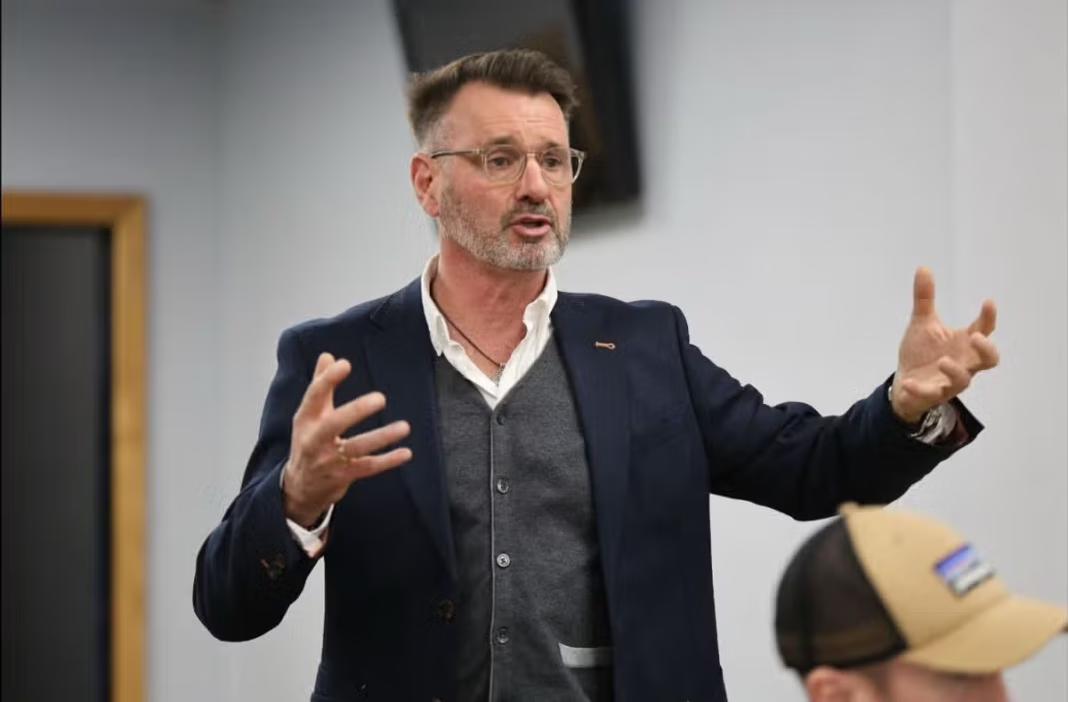
Few people have experienced Welsh rugby from as many angles as Dai Rees.
Over almost three decades, he has coached across the community and professional game, worked with Wales Sevens, Wales Women and national age-grade teams, and spent four years in Hong Kong helping to oversee player development.
Now, after being elected to the Welsh Rugby Union council in place of Anthony Buchanan, who stood down after losing confidence in the WRU leadership, Rees believes he has an opportunity to help shape the game’s future at one of its most challenging moments.
But despite the headlines surrounding Wales’ struggles on the field and the proposed reduction of professional clubs from four to three, Rees insists the biggest issues facing Welsh rugby lie elsewhere.
JOIN OUR WALES RUGBY FACEBOOK PAGE Latest news, analysis and much more
Instead, he believes the sport’s future depends on retaining young players, modernising coaching and strengthening the pathway between junior, community and elite rugby.
“I’m hoping I’ve got a little bit of experience to bring to the board,” Rees told WalesOnline.
“It was a tough decision because I wanted to make sure I could make an impact in this role and I feel like I can.
“It was voted on by all of Wales which was important. I didn’t want a district role because I wanted to be able to contribute across the strategic direction.”
Unlike WRU executives, council members serve on a voluntary basis, helping shape strategy while also acting as a bridge between the union and the grassroots game.
“My role is to support strategy and the full-time staff within the union,” Rees explained.
“When they have concepts and ideas it is to bring reality and actual feedback from within the community game and the transition game.
“I am there to support and challenge concepts while also lending that supportive ear.
“The full-time staff should be presenting strategy and I should be sat there going, ‘Are you sure that will work? Do you think we ought to do it like this?'”
Discussion around Welsh rugby has been dominated by the future of the professional game in recent months, but Rees believes focusing solely on the regions risks missing the bigger picture.
“We are in a good space considering we are a small nation,” he said.
“We are reflecting no differently to the rest of the world including New Zealand.
“The participation in rugby in general is declining.
“You have hotspots or pinch points.
“Those pinch points are non-contact to contact, U16s to U18s and U18s to senior rugby.
“Our big challenge in the community game is 14-18 and then 18-23.
“Those two phases are critical because they show the biggest drop-offs in every nation in the world.
“Modern kids have so many different options, whether that’s other sports, careers or social lives.
“We have to make rugby the highlight of their week.”
For Rees, the next stage is improving the pathways that take players through the game and developing the coaches responsible for guiding them.
He believes Welsh rugby must rethink how it supports players during the crucial years when many decide whether they remain involved or walk away from the sport entirely.
“We are healthier than the rhetoric and all the headlines suggest because we’ve still got bodies coming into the game,” he said.
“The message is we have changed but it is not visible yet.
“The systems and structures that have been put in at the union over the past 18 months, along with the different practices as a result of a number of damning reports.
“Those systems have been implemented and continue to grow behind the scenes but they don’t make the headlines because 18 losses on the trot at senior level do.
“But that damage was done 15 years ago, not by the current staff. My opinion is there was a neglect of the player and coaching pathways over a 12-15 year period.
“Steve (Tandy) is now rebuilding the squad but we’ve had these phases before.
“The data collection that is being done now will hopefully remain in the union for years to come and be built on.
“It’s the first system we’ve had in over 100 years where clubs are not just passionate but having to make decisions and become accountable for how they act.
“They need the right systems in place, the right medical teams in place and all the safeguarding in place.
“We’ve never had that before.
“But there’s a lot of work to be done in player pathways and coach development between 14-18 and 18-23.
“With our data collection, if we can review structures in those two areas and develop those, we will soon see the benefits.”
That, Rees believes, is where he can make the biggest contribution.
“That’s what I feel is my area of expertise that I can bring,” he said.
“I will join the dots in those two areas because I am an experienced coach who has worked in pathways and development.
“That’s what I did for 12 years in Hong Kong, while I’ve also worked with New Zealand and Australian pathways. We had partnerships with English clubs.”
But he believes the challenge is not simply about producing better players. It is also about changing the environment they develop in.
“We have got a unique rugby culture which can become a massive strength or we beat ourselves up by focusing on all the negatives.
“When I played I was never told what I was good at, just what I was doing wrong. But that’s our culture.
“We’ve got to try to flip our culture around. It’s the how now.
“How do we get Welsh people to coach differently and review their practices?
“They need to put their hand around the kid rather than give them a bollocking for making a mistake.”
Rees believes the modern player has different expectations from previous generations and says rugby must adapt if it wants to keep them involved.
“Our coach development has to shift and be more focused on people development, emotional leadership and how we treat people,” he said.
“The people that impact the people on the ground are our coaches.
“I’d like to see a massive difference in the content we present.”
He says Welsh rugby has been slow to respond to changing attitudes among younger players.
“I’ve done a fair bit of work on generational dynamics and we haven’t made a particularly big shift in the Gen-Z category, which are our current players from 30 downwards,” said Rees.
“They want different things out of rugby and life.
“If we’ve got older coaches like me who still coach how we were coached, you’ll push people away from the game.
“They aren’t pain-driven anymore, shouting in the mud. They like a bit of love and emotional intelligence.”
The consequences of failing to adapt, Rees argues, are being seen in the number of players who leave rugby completely after missing out on professional contracts.
“It’s that space of 14-18 and 18-23 which determines which players go into the top echelons or drop into the community game,” Rees explained.
“Both are vitally important because good players who don’t quite make it at the top are still so valuable to the game.
“What’s happening at the moment is if they don’t make it, a high percentage just drop out of the game completely.
“So that experience they’ve had of maybe playing age-grade rugby or U20s or being in a regional academy, a lot of those say, ‘Well, I haven’t made it, so I don’t want to go back and play for Monmouth or Cross Keys.’
“They drop out of the game.
“We have to work together as the constituent parts of the game.
“At the moment there’s two, but I think there’s three: middle phase development.”
Rees points to the example of regional age-grade rugby, where a small number of players are selected for elite pathways while many others risk being forgotten.
“If you look at the regional age-grade competition where 36 boys get together at each region,” he said.
“I always said when I was at the Dragons: don’t worry about the four that have been picked for the senior academy, what are we doing with the other 32?
“Why are we not saying what club are you going back to? How are we supporting you?
“That isn’t managed well enough at the moment.”
For Rees, that is the challenge facing Welsh rugby now: not just producing the next generation of internationals, but making sure everyone who enters the game has a reason to stay.
Rees believes the rebuild of Welsh rugby starts long before players pull on the red jersey.
It starts in clubs, on cold winter training nights and in the relationships that determine whether the next generation stays in the game or walks away from it.
Follow all of our channels to ensure you stay up to date with the latest Welsh rugby news. Sign up to our free daily newsletter here and our WhatsApp channel here for all the breaking news.