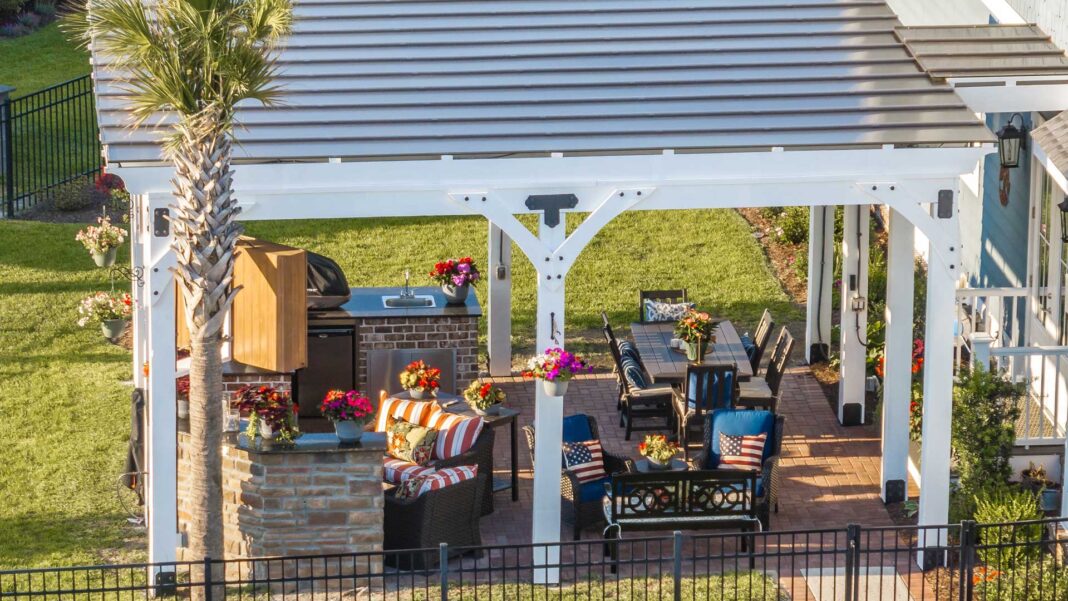

The problem is rarely bad luck. In most cases, early failure can be traced back to a small number of predictable causes that start working against a structure from the day it is built.
Understanding those causes is the first step towards avoiding an expensive rebuild. From the way water moves around a structure to the type of metal used in its fixings, the details that are easiest to overlook are often the ones that decide how long an outdoor project survives.
Moisture is the biggest enemy
Timber and water have a complicated relationship. Wood naturally absorbs and releases moisture as the weather changes, swelling in wet conditions and shrinking as it dries. That constant movement loosens joints and opens up small gaps where water can sit.
When timber stays damp for long periods, decay sets in. Guidance from the USDA Forest Products Laboratory notes that wood kept below around 20 per cent moisture content is generally safe from fungal decay, while wood that stays wetter than that for extended periods is at serious risk. Boards laid tight against one another, posts buried directly in soil and horizontal surfaces that hold standing water all keep timber above that threshold far longer than they should.
Poor drainage speeds up the damage
Moisture becomes a much bigger problem when water has nowhere to go. Decks built on flat ground without a slight fall, pergola posts set in hollows that collect rainwater and fence lines running along the bottom of a slope are all exposed to repeated soaking.
Good drainage starts before construction. Grading the ground away from the structure, leaving gaps between deck boards, using gravel around the base of posts and keeping timber clear of soil contact all help water drain away quickly instead of pooling where it can cause harm.
Inadequate foundations cause movement
Every outdoor structure relies on what lies beneath it. Footings that are too shallow, too small or poured on soft ground allow posts to sink, heave or tilt over time. Once a post moves, the load shifts to the surrounding joints, which were never designed to carry it.
A solid concrete footing or slab, sized for the structure and the local ground conditions, gives a stable base. But even the best concrete foundation is only useful if the structure is properly connected to it.
Unsuitable connections weaken the whole build
This is where many projects fall short. Connections between timber and concrete, and between one piece of timber and another, carry loads of weight, wind and everyday use. If those fixings are undersized or designed for a different material, the structure loosens and eventually fails.
For connections to slabs, footings and masonry, purpose made concrete fixings provide a far stronger and more reliable hold than standard screws and plugs. Concrete anchors such as screw bolts cut their own thread into the concrete as they are installed, creating a secure grip for post brackets, stirrups and base plates. Homeowners and builders can find a range of options among concrete construction fasteners designed for different loads and applications.
For timber to timber joints, coach screws are a dependable choice. Their coarse thread and hexagonal head allow them to pull heavy timbers tightly together, making them well suited to fixing beams to posts, ledger boards to frames and rails to heavy fence posts. Pre drilling a pilot hole and using a washer under the head helps prevent splitting and spreads the load evenly.
Corrosion quietly eats away at fixings
Even the right type of fixing can fail if it is made from the wrong material. Steel exposed to rain, coastal air or chemically treated timber can corrode surprisingly quickly, weakening joints from the inside long before any visible damage appears.
The scale of the problem is significant. A global study by NACE International (now AMPP) estimated the worldwide cost of corrosion at around US$2.5 trillion a year, equivalent to roughly 3.4 per cent of global GDP. The same study found that applying proper corrosion prevention practices could cut those costs by between 15 and 35 per cent. For homeowners, the lesson is simple: choosing hot dip galvanised or stainless steel fixings for outdoor use is one of the most cost effective decisions they can make.
Five steps homeowners can take
For anyone planning a new outdoor structure, or looking to extend the life of an existing one, a few practical steps make a real difference.
- Keep timber off the ground and allow gaps between boards so water can drain and surfaces can dry.
- Shape the surrounding ground so rainwater runs away from posts and footings.
- Build on footings or slabs that suit the size of the structure and the local soil conditions.
- Use concrete anchors for connections to concrete and coach screws for heavy timber joints, following the manufacturer’s installation guidance.
- Choose corrosion resistant fixings suited to the environment, particularly near the coast or when working with treated timber.
Built to last
Outdoor structures do not have to fail early. Most premature problems come down to moisture, drainage, foundations, connections and corrosion, and each of these can be managed with careful planning and the right materials. A little extra attention during the build can add many years to the life of a deck, pergola or fence, and save homeowners from paying for the same project twice.
This article was produced in partnership with Anzor.